Tuesday, December 21, 2021

Adventures of Sugar and Pequeño

Over the years, Sharon and I have discovered we have a bit of a menagerie here in the desert. This assortment of curious critters ranges from the ever-elusive road runner to egrets, amorous bunnies, high-flying hawks and crows, bold coyotes, an occasional bobcat and lots of hummingbirds.


Wikipedia does a great job of describing our fascinating aerial interlopers:

‘Hummingbirds are birds native to the Americas and comprise the biological family Trochilidae. With about 360 species, they occur from Alaska to Tierra del Fuego, but the vast majority of the species are found in the tropics. They are small birds, with most species measuring 7.5–13 cm (3–5 in) in length. The smallest extant hummingbird species is the 5 cm (2.0 in) bee hummingbird, which weighs less than 2.0 g (0.07 oz). The largest hummingbird species is the 23 cm (9.1 in) giant hummingbird, weighing 18–24 grams (0.63–0.85 oz). They are specialized for feeding on flower nectar, but all species consume flying insects or spiders.

The common ancestor of extant hummingbirds is estimated to have lived 22 million years ago in South America. They are known as hummingbirds because of the humming sound created by their beating wings, which flap at high frequencies audible to humans. They hover in midair at rapid wing-flapping rates, which vary from around 12 beats per second in the largest species to around 80 per second in small hummingbirds. Of those species that have been measured during flying in wind tunnels, their top speeds exceed 15 m/s (54 km/h; 34 mph). During courtship, some male species dive from 30 metres (100 ft) of height above a female at speeds around 23 m/s (83 km/h; 51 mph)’.

In years past, our hummingbirds usually showed up around February or March when our flowers began to bloom. We would put out a couple of feeders but they never seemed to attract the small birds any earlier.


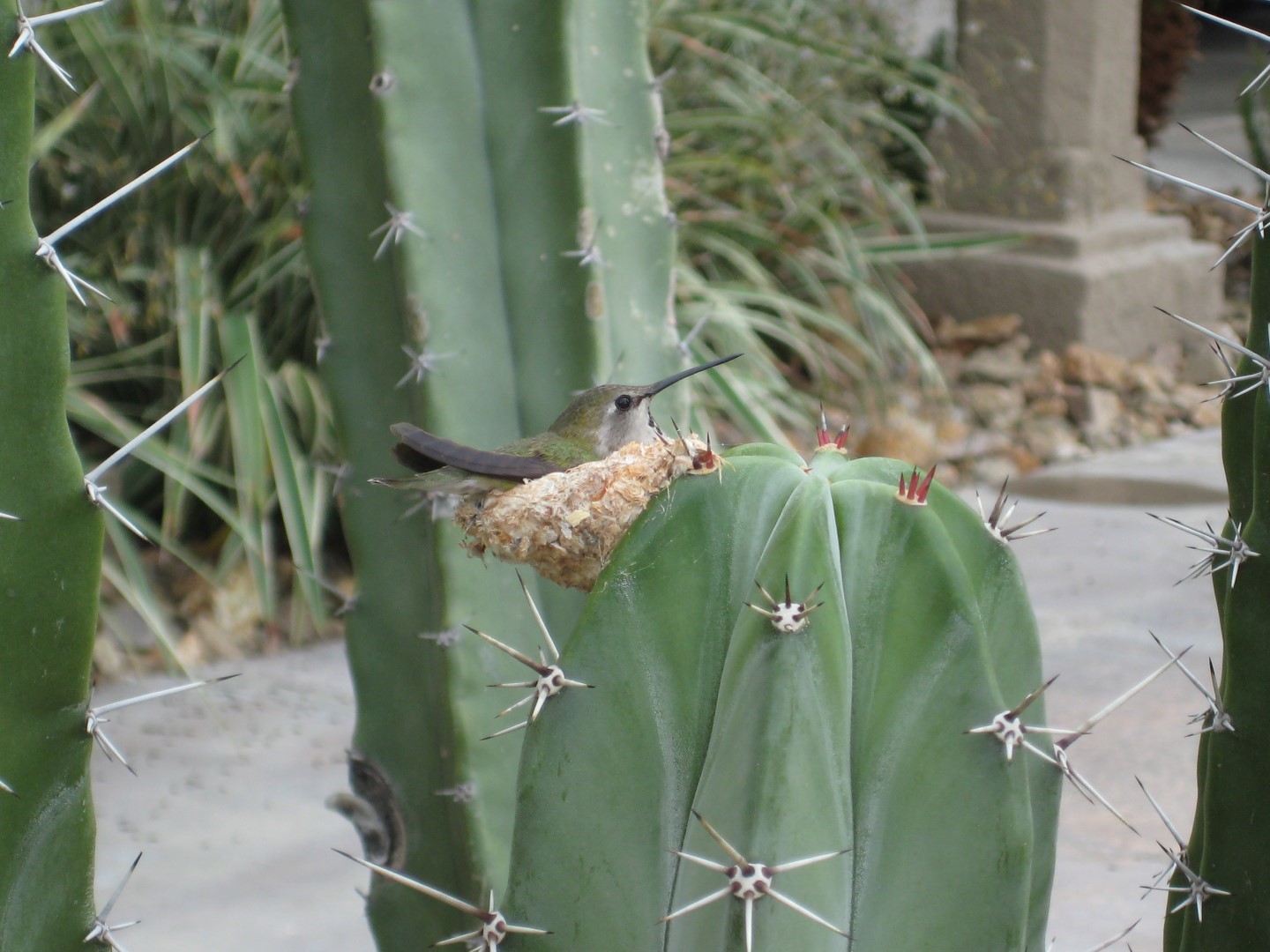
Eventually as we got used to the birds and they to us, Sharon and I began to pay more attention to those tiny elusive creatures. Then on day, we stumbled upon one of their nests in our front yard. For some strange reason a mother hummingbird decided that a cactus by our door was the perfect place to build a nest and start a family.


When we discovered the nest, it became a game hide and seek between us and mother. Either Sharon or her friend Linda would slowly, carefully slide up to the cactus and try to photograph mom and her babies. It became a game of cat and mouse or more appropriately, Sharon, her friend Linda and mother hummingbird. Both Sharon and Linda were dive-bombed several times when they got too close to the nest. But their efforts were worth it.


Then last summer we began to grow our extended family of hummingbirds in our backyard. In our absence, Linda spent a lot of time around our house, using our pool, working, reading and relaxing. She put up several hummingbird feeders and watched in amazement as a whole family of the tiny buzzing birds began to descend on our property. In short order, we had a family of more than a half dozen hummingbirds safely ensconced around our backyard.


The year before, Charlotte had named one of the birds Sugar and that name stuck. So, it became a game of finding and identifying Sugar as the birds buzzed above our heads or sat on the outdoor fan and looked down on all of us.


Linda decided to name one of the most beautiful birds of the group: Pequeño. This hummingbird has a beautiful vest of deep reflective purple that also quickly identified her as the most aggressive feeder closest to our back slider.

When the kids came here for Thanksgiving, Nana had finger food rings for each grandchild to wear in hopes of feeding the tiny birds. Maya was the most patient and she was able to capture on film and video, herself feeding Pequeño.


We were also able to capture a mother hummingbird feeding her newborn. It was a marvelous picture of nature and the bond between mother and her youngest offspring. Even in the bird world, some things never change.


Tuesday, December 14, 2021

Working Class Crossover

Most of us, whether we’ll admit it or not, have areas of interest that might surprise a lot of other folks. Where this subject matter comes from is less important than the depth to which this focus can grasp at and hold tight to our reflective consciousness. Some people might call them our ‘hot buttons’ or for others, their ‘touchy subjects’. No matter the moniker, the subject in question often seems to capture our attention and hold it tight.


I am guilty of a number of these inquisitive infractions. For whatever reason, I find my attention drawn to a wide variety of subject matter. ‘Class in our society’ is certainly one of those areas of interest. In my mind, it ties in nicely with ‘The American Dream,’ ‘Class Consciousness,’ and (the old favorite of mine) ‘risin above your raisen.’


Over the years, I’ve read several books on class. It’s a subject matter that has long since fascinated me on a very personal level. Perhaps the thin fabric of my upbringing had a lot to do with it. Growing up, it certainly wasn’t the glamor of wealth or accumulated material possessions that caught my attention. Instead, I think it was the place American society had sketched out for me as a child based on my social, economic, and cultural upbringing.


Both my grade school and high school slotted me into educational tracks based on my test scores. My family structure certainly didn’t help advance any educational chances at success. There were sometimes understood and other times openly stated assumptions that I would follow a pre-ordained path and certainly never give any thought to ‘rising above my raisin'.’ My mother and father did just that. My grandparents the same. That simply was the way it was and always had been.


One of the chapters in a recent book about class talked about working class folks who, usually inadvertently, get a taste of another life outside of their own realm of existence. The example was a young woman who was taking college classes at night to get a promotion at work.

What she found to her amazement was her newfound ability to grasp the material and delve into it at a deeper level than she ever thought possible. She was encouraged by her teacher and fellow students to continue her pursuit of knowledge. But this is where it got complex and ugly.

Her boyfriend didn’t like the time she was spending in class and not with him. Her parents worried that she was hanging out with ‘those’ people who would give her ideas about her own class and status in life. She was treading where few of her family and relatives had ever gone before. And it made them all very nervous.


‘Educating Rita’ as a wonderful example of these phenomena. Educating Rita was a 1983 movie starring Michael Caine and Julie Walters. A woman takes night classes at ‘the university’ and finds to her amazement that she has the knowledge and talent to succeed there. But forces in her life all seem to conspire against her. Think of this romance/drama as the American Dream without the violins and background music. Instead you’ll hear the scrapping of fingernails on a blackboard and the vision of the future that can’t be reached.

Another good example of this idea is the movie ‘Rudy.’ Based on a true story, ‘Rudy’ does a good job of examining the complex and confusing roles that class places on folks seeking to break out on their own mold and for those who watch them leave the fold.


One of my first novels ‘Love in the A Shau’ painted a picture of just this scenario with my main protagonist. I also touched on this concept briefly in several blogs: ‘Damming the Intellectuals’ and ‘Rising above Your Raisin’ as examples of social and economic crossovers.  Another recent blog entitled: ‘Book of ‘61’ talked about the caste system at my old high school.


That caste system (strictly my words and impression only) at Cretin High School was neither good nor bad, right nor wrong. It was simply recognition by the administration that some students were better prepared for a college-bound track of studies than other students. Test scores were the primary indicator of this placement but I’m willing to bet that socio and economic factors also played a role in that determination.

Class is a worn out pathway we are forced to follow until such time that we consciously select a different route to travel. It is a conscious, and perhaps at other times, a subconscious decision to follow our heart and head instead of directional cues from those around us. It might mean leaving behind friends and family who choose to stay in place.

But in the end, it is being true to oneself and seeking fulfillment where it means the most…to you…consequences be damned.

Tuesday, December 7, 2021

Raising Thespians

My classmates and I never performed in plays in grade school. The first time I heard a play was going to be performed at our all-male high school, I was shocked. We didn’t have a Theater Arts Department or anything even closely akin to that. A Crack Drill Team, yes but female actors; never!

Yet somehow one of our male teachers convinced a female teacher at an all-girls high school that our military school should put on a performance with their talented other half. To be honest, I can’t remember the name of the play, what it was about or even remotely thinking of attending it myself.

What kind of guy would be in a play, pretending to be somebody he wasn’t? Besides, I convinced myself, the thought was acting out in front of other people, especially young women from one of those other schools was terrifying at best.

My first exposure to the theater was at a small (and I mean tiny) community theater in my neighborhood. It was called the Edith Bush Little Theater. I’m guessing it was probably the idea of my college girlfriend at the time. She certainly had more taste and sophistication in her little finger than I did in my entire body.

I do remember enjoying the performance (a romantic comedy) and thinking that I’d like to return to the theater again.


The second play I saw was ‘The Fantasticks’ in 1964 at a little theater on North Beach in San Francisco. A new member of our barracks invited me to accompany him to the play. He was a recent transplant from Germany and had been drafted almost before he and his family touched feet on American soil.


The play touched me in a number of ways. I had been drafted into the Army just six months earlier and been assigned to the Presidio of San Francisco. I was away from home for the first time. I was missing my girlfriend and envied her weekends with ‘friends’ on campus. Most of my buddies were still in college, completing their education while I had been derailed for two years before finishing my own. I was feeling very sorry for myself. The play only embellished and enhanced those feelings.

When the song ‘Try to Remember’ was performed, I thought I was going to burst into tears. God, that play was memorable! I realized then and there how the power of a good storyline, strong character performances and wonderful music could impact an audience. That first taste of creativity never left my mind or determination to find it on my own.


Since then, I’ve acted in a number of plays in Tennessee and Minnesota. I’ve stage-managed plays, directed some and have written 14 plays, of which four have been produced. Back in 2018, when we took both families to London and Paris, we made sure the grandkids went to see ‘School of Rock’ on the West End. The kids loved it.

So, it was only logical (at least in this family) that when our families gathered together for either Thanksgiving or Christmas, our grandchildren would be roped into performing in a play written by Papa. That process began three years ago.

The first play we did was entitled: ‘Kitten’s Bad Day.’ That was in Christmas of 2018. It was scripted reading and for an inaugural event the kids just read the script and added their own take on the words.


The second play we did was entitled: ‘Animal Clappers’. That was performed during Thanksgiving week of 2019. For this play we added puppets and Cash, the wonder dog, curtesy of the Colorado Kids.


Since we had a gap of almost two years because of the pandemic, I wanted to do something special for our next family gathering during Thanksgiving week of 2021. We agreed to do a musical this time around. Maya, our eldest granddaughter, had been singing in choirs and as a soloist since grade school. Her sister, Samantha, recently began practicing the ukulele.

So here is our new play simply entitled: A Thanksgiving Musical, 2021. Here it is.

Enjoy.