Showing posts with label world war two. Show all posts

Tuesday, April 14, 2026

Swig is Just a Repeat of Itself

Photo courtesy of Jerry Hoffman

Swig and Sota are two of the newest drink fads grabbing teenage imaginations. In case, you’re over the age of twelve and out of the loop, both of these drinks are newly manufactured liquid concoctions old timers like me would call a witch’s brew. Back in the day, at my corner drug store, it meant a glass of Coca Cola with a squirt of chocolate, cherry or vanilla syrup mixed in. A decade later, in Sharon’s Wabasha, they called it a suicide drink. Some things never change when it comes to tempting the virgin palate.


Along the same lines, my daughter and I have this ongoing discussion about changing times and opportunities. She believes that Sharon and I had it easier growing up, raising kids, buying our first house and so forth. “Yep, you guys had it easier than my husband and I have had doing the same thing.”


Not so, say I. Different times, yes. Different challenges, yes. Different social-economic-political pressures from both sides to taint and/or coat the equations of differences, yep. But, at its most basic level, not a whole lot has changed over the decades.

Now, I will admit that I have a distinct advantage over my daughter with my own miles traveled. I have earned the education, information and life scars gleamed over a lifetime of living. In turn, that has benefited me with the ability to look back and see remarkable similarities.


We live in a world today that is rift with misinformation and propaganda from both sides of the political aisle. Artificial Information has enhanced the dissemination of information but also spread mistrust and illusion in its wake. For many of us, it can be discouraging at times. Yet, in reality, some things never change. History really does repeat itself.


A quick glance back at historical events paints quite an interesting picture. Every generation thinks it has discovered sex, will end all wars, is the best collection of humanity around and knows more than any other generation. The world of business is one good example of this.


Today’s Wall Street darlings all hype the same mantra; new, innovative, ground-breaking, revolutionary, etc. History tells a different story. The reality is that the world of business is constantly changing, evolving, growing out of date and at the same time being truly innovative. The brightest stars of today could be the relics of tomorrow by this afternoon.

Block Buster once ruled the home video market. Then, upstart Netflix came along with their revolutionary idea of sending DVDs in the mail. Now, Paramount is trying to dislodge that giant of streaming content with its own version of content distribution.

In the 50s and 60s, IBM was ‘it’ in computer technology until a little upstart in Seattle sold them it’s operating system and kept the rights for themselves. Now, Microsoft is competing with other surviving giants in the newest fields of AI (artificial intelligence) and quantum computing.


After World War Two, Sears Robuck, Montgomery Wards and old stewards like the Emporium dominated the retail world. Now Walmart and Target have taken their place and even Target has stumbled recently. Uber and Lyft replaced Yellow Cab. Airbnb edged out Hilton and Marriott in the lodging business.

In historical terms, nothing ever stays the same and whatever goes around, comes around. Time changes everything.  Civilizations are born, grow and die over time. Innovation changes the world and it stays the same. Nations and nationalities become convinced they are the conquering force and then they aren’t.


Japan and Germany went totalitarian in the 1930s, trying to conquer the world. They never did. Japan tried to conquer Vietnam during World War Two and failed. Then the French tried to continue their colonial rule. They couldn’t. The Americans also tried and failed. Afghanistan was no different. First, it was the Russians then the Americans. Neither country was able to dislodge the ethnic, religious and political forces tearing the country apart. Now Israel and America are trying to do the same thing in the Middle East with Iran. See a pattern here?


Education is paramount for Melanie’s children’s advancement as it is for the Colorado cousins. Compared to the standard approach in achieving a college or tradesman degree my generation had to follow, nowadays, educational opportunities mean almost endless possibilities unheard of only a few decades ago.


High schoolers, as well as adult students, are inundated with extracurricular activities of every scope and area of interest. There are AP (advance placement) classes available. Community and Technical Colleges play a critical role in furthering education for those unable or unwilling to follow the four-year traditional approach. On-line educational courses, Adult Ed classes, and correspondence classes can all lead to advanced studies toward a MA and PhD degree. It is no longer a case of one single approach for everyone to follow.

Everything seems fluid except for one reality. There is still hope in age-old values and a common-sense approach to life.  Those basic core values of hard work, determination, common sense, thrifty smart vs stupid cheap, ambition, etc. It’s the same philosophy of life that’s been around forever.


There is nothing new in this category. While ‘Think and Grow Rich’ may have grabbed the reader’s attention in the early thirties, the mythical tale of rags to riches by Horatio Alger had already arrived at the turn of the century. The Sixties and Eighties philosophers followed suit as did Tony Robbins later on.

‘The Basics’ as old school teachers have preached for centuries are still has tried and true as they were back then. Hard to remember with all the distractions around but still as reliable as ever. So, yeah, some things change and some things just come on round back again.

Tuesday, June 12, 2018

Fortress Singapore


I found it interesting that the President decided to use Singapore as his meeting place with the dictator from North Korea. Singapore is a fascinating country in that it chose, a long time ago, to follows its own path into the Twenty-First century.


Its strict laws have been criticized by Westerners as barbaric and cruel by our standards. Nevertheless, their adherence to conformity hasn’t diminished their success in the marketplace; regionally or worldwide. I found Singapore to be at once modern and ancient, congested and clean. It felt extremely safe for a large metropolitan area.


We traveled to Singapore as part of an Asian trip when Sharon was President of her local Rotary club in Apple Valley. After Singapore, we traveled through Bali, Thailand and Hong Kong. Without a doubt, Singapore was the highlight of our trip.


Long before that trip, there was a special place for Singapore harbored in my imagination. That fascination with the Island State had been fueled years earlier while I was still in high school. Two books by one of my favorite English authors, Alistair MacLean, began this life-long interest with World War Two; especially the early stages of Japanese conquest of the Far East.


Alistair MacLean’s first novel was entitled ‘H.M.S. Ulysses.’ It was based on the infamous Murmansk run. A dangerous convoy trip from America and England to send supplies to Russia. One of the most lethal convoys was the Murmansk Run across the North Atlantic and from Iceland to the Russian ports of Murmansk, Archangel, and Kola Inlet. It involved more hazards than in any other kind of naval duty. In addition, prior to the spring of 1943, when an effective Allied antisubmarine offensive got underway, ships and men making the so-called “Murmansk Run” had about a one in three chance of returning alive.

The icy waters of the North Atlantic and hunter-killer U-boats meant certain death to any crewman unlucky enough to have his ship torpedoed during the trip. Hence the great song by Woody Guthrie ‘The Rubin James.’


The second novel, which tied directly to the fall of Singapore, was entitled: ‘South by Java Head.’ Winston Churchill had called Singapore the “Gibraltar of the East.” An impregnable fortress at the heart of the British empire in the Far East.


When the island fortress fell to Japanese forces on February 15th 1941, it marked the beginning of the end for the British Empire’s extended colonies. The ‘jewel in the crown of the British Empire’, India, gained independence in 1947. Other British holdings followed: Burma in 1948, Malaya in 1957, and Singapore soon after. And it all began with the fall of Singapore.


I’ve already written a 30-page treatment for my own novel about the fall of Singapore. It’s entitled: ‘Siloso,’ named after the last British fortress on the Island to fall to the invading Japanese soldiers. Right now it patiently waits behind other treatments for plays, screenplays and novels each shuffling around in my brain, trying to grab my full attention and a place at the head of my ‘to do’ list.

Tuesday, February 23, 2016

The Generation that Love Forgot


Perhaps I should have titled this blog: Why can’t they say ‘I love you.’ It’s been a recurring theme in conversations I’ve had with so many adults my own age. That is, the inability of our parents to show or express love and affection to us growing up. I thought I was the only kid on the block that didn’t have affectionate parents. Turns out I wasn’t alone; not by a long shot.

Mind you this awareness didn’t come to me through research or probing questions. Instead it just evolved through casual conversations over coffee or a beer that somehow drifted back to our childhood. It was initiated by our observations of how our role as parents turned out to be so different than that of our parents. Paramount among those differences was our willingness to show love and affection to our kids and grandkids.


It’s easy to excuse our parent’s behavior (not all but certainly a large number) as simply traditional German or Scandinavian traits handed down through the centuries and continued on with our own parents. It would seem that a part of that ancestral tapestry has always included images of the stoic German and reserved Scandinavian whose warmth and compassion reflected the cold harsh land of their forefathers.

Much as we like to attribute certain traits to specific nationalities; Italian cooking, French romance, English nobility and Asian industriousness this lack of warmth crosses all nationalities. It might still dwindle into a simple cliché if not for those personal examples from my friends that give credence to those inferences of parental shortcomings.

When our conversations morphed into parental roles and responsibilities I realized just how differently I see my role as a parent relative to that of older generations. I haven’t done any Ph.D. research or quantified my findings. But my gut tells it all. Enough of my friends have lamented the lack of affection from their parents to make me believe it isn’t just my over-active imagination or jaded memories that have clouded that part of my past. To me it is real and curious.

So what happened back then to make that generation so cool to their kids? Maybe a key lies in this whole adulation thing about the ‘greatest generation.’


It’s certainly true that that generation suffered during the depression and fought to keep the world free in World War Two. But something was lost along the way for some of them. Perhaps it was the harsh conditions growing up in the depression or pressure from their own parents to find food for the table and shelter over their head. Perhaps losing a loved one in the war or trying to build a family foundation after the war brought undue stress to their lives. 

The causes and conditions could be many but the results seemed always to be the same. That is, the inability of so many of them to become loving parents who knew how to express love for their children.

The outward manifestations (and thus perhaps causes) are many and some very complex. Single parent households (my own situation), elderly parents, a marriage fractured by the war, a labor-intense life fueled by liquor or alcoholic parents.  And those are just some a few examples coming from those adult children willing to reveal their growing up experiences with me.

Some will defend their parent’s actions are’ normal for the times.’ They’ll point to our own inability as children to grasp the subtle signs of affection that may have lingered just beneath the surface as compared to our own full frontal affection as we displayed it today. Perhaps they’re right and our parents did love us…but just couldn’t show it.

Intentions are noble but actions speak louder than neatly arranged words meant to convey affection. Talk is cheap. Visible displays of concern, encouragement and affection take time and effort.


The excuse I’ve heard over and over again is that ‘they’ weren’t raised that way. It wasn’t a part of their culture or heritage. It was the way it was and wasn’t ever going to change.

Taking that argument at face value means that none of us would have ever become caring, concerned and affectionate parents. ..because we never saw it in our own parents. Luckily that hasn’t been the case with my friends who experienced a rather lukewarm upbringing. None of us has let that become the soundtrack of our own lives.

Luckily for our kids and grandkids, that circle has been broken.

Thursday, December 20, 2012

Gold Coast ... the Wild Coast

The Chinese have a saying that a journey begins with a single step. I’d change that a little to say a real journey often begins in naivety, progresses to actuality by accident and somehow finds its place in one’s memory bank through sheer happenstance, perseverance and dumb luck.

Like some wonderful party that can’t be replicated afterwards even if all the same participants gathered together, once again, at the same place; a journey is really a time capsule. It’s a sliver of space in one’s life that gives birth to either good memories or bad, to wonderful thoughts or sad reflections. Yet it always remains locked in that serendipitous turn of events which can never be changed, replicated or replaced. Whatever happened did happen. Whatever was gained can’t be changed even if it later becomes lost on in a fog of future events.

A few months ago, I reflected on my experiences in San Francisco in my blog “Young Heart by the Bay.”  A tiny fraction of that experience was a road trip I took back in the autumn of 1964.

It was my first real road trip.

The idea was born early one Sunday morning in some unnamed dive bar on North Beach.


We were a motley assortment of drugstore cowboys, fast food aficionados and one kid with two years of college under his belt. Each of us ruminating on about our pending release from military service a monumental two years away. This was long before “Easy Rider” and my own sojourn to Danmark.

What were we going to do after the service? Return to college. Head out for Europe. Stay in San Francisco or hit the road just like Jack Kerouac did in “On the Road.”

The more sober philosophers among us thought we should get on with our lives. We should go back home after our hitch was up, get an education, marry our college sweetheart and settle down to the good old standard American life. The more inebriated among us thought otherwise. Another round of beers and an impromptu survey was taken. The open road garnered first place with Europe a close second. Returning home to suburban tranquility didn’t even register.

Some of us were already open road desperados. One guy had a big-ass Triumph 650cc motor-cycle with enough horsepower to fly between San Francisco to Los Angeles in record time. He went down to the city of angels almost every weekend to see his girlfriend. That is until a transfer landed him in the middle of nowhere Indiana in a snowstorm and his bike went into cold storage.

A couple of guys had souped-up cars they’d brought to the Presidio from back home. But soon one fellow was shipped off to Vietnam and another got transferred to Okinawa. Several more wannabes disappeared when sobriety raised its ugly head. So that effectively took most of my gang out of the picture. I was the only one left with my Vespa motor scooter and exaggerated, romantic notions of the open road still spinning around in my head.

A dream had been ignited in my plastic brain that resonated throughout my body. I decided I might as well hit the asphalt right then and there instead of waiting another two years before my release was up. My destination would be the distant lands north of the Golden Gate Bridge. At that point, they were just shadowy mounds of gray that kissed the skyline outside my office window.


This was the old Northern California countryside before multiple ballot propositions changed the political and social landscape and a bulging San Francisco spilled its inhabitants far and wide; spilling out across the bay to once tiny hamlets like Sausalito, Mount Tamaulipas and Stinson Beach. A time when cows roamed empty fields amid gun emplacements that still protected San Francisco bay from Japanese battleships. An era, before satellites, when radar stations scanned the northern skies for raiders from Russia. A time when only a few small enclaves of new housing slashed into the green hillsides. A time when the only sound heard was the putt-putt of my tiny Italian engine against a wind blowing ocean-side and birds on high, floating silently in the sea breeze.

So one Monday morning, instead of heading to work at the Command Information Office, I saddled up my trusty stead, wrapped supplies on the saddle rack and crossed the Golden Gate Bridge for points north.


After I had braved the crazy traffic on the bridge, I swung north to the tiny enclave of Sausalito. Even back then Sausalito was a very special place. During the war, the Navy had installed a host of ship maintenance facilities. By the sixties those had all disappeared but a lot of the ship workers had stayed. They were joined by displaced beats and hippies from across the bay. Together they made Sausalito an eclectic community, a growing artist colony and home to the funky and weird.

I got my regular cup of Joe and sat on the dock, peering out across the bay back to my new life and home and I wondered where the road might take me next.


On the way out of town, I spotted this inlet where fancy cars were parked in front and yachts in back. It was a novel idea at the time, priceless in this day and age. 


Later that morning, I stopped at the Christian Brothers winery. I didn’t see any of my old high school teachers there but a couple of glasses of vino did wonders for the rest of my trip that afternoon.


The first sign of encroaching humanity. The pristine countryside of Sausalito was becoming just another suburb of San Francisco. 


Some rundown motel among the sequoias was my refuge for that first night. Exhausted, dirty and yet feeling exhilarated. Note the sleeping bag I had hauled along. What was I thinking?


This was one of dozens of inlets along the coast road where the sea had dumped its collection of driftwood and debris on land. I’m sure there were treasures down there but I never stopped to investigate

 
I was so tempted to ride down to this house to see who lived there. I can’t image a more remote, mysterious and wonderful place to live. It was probably some writer toiling on the great American novel and suffering the pangs of a broken love affair.


Back along the bay, I came across this new military housing complex being built. The view out their front door was to die for.


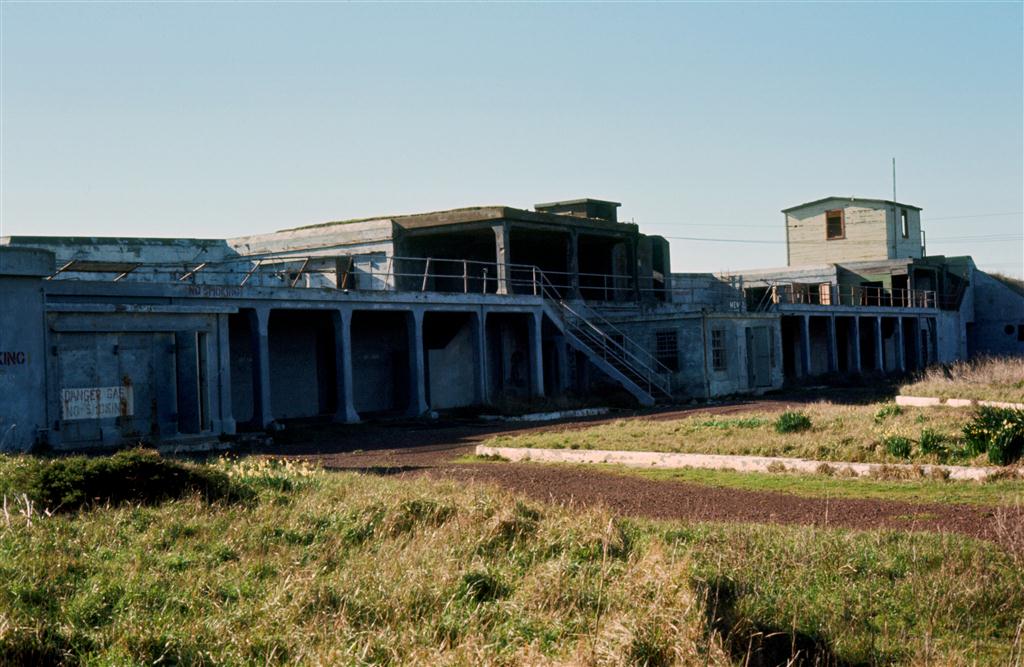
But more fascinating were the old World War Two defensive installations that ran up and down the bayside. A concrete collection of pillboxes, command centers and the foundations for large cannons which would have been pointed out to sea.


Then behind those old fortifications was a new radar facility and cameras pointed down at a kid on a scooter who was peering up at them.


Some of the dozen places along the coast where I was lost and didn’t really care. I had gas to go and wanderlust running rampant through my veins. 


By the end of the week, I was flying with wild abandon. Yet I only crashed once, taking a curve too fast on wet leaves and ending up in a gully sans my glasses, hat and pride. The scooter was OK except for the mud and leaves that coated its undercarriage with brown muck.  I found my glasses, picked the dirt out of my teeth and climbed back up on the saddle again.

During that week, one song in particular kept bouncing around in my head. “Four Strong Winds” by Ian and Sylvia. It spoke of loss, separation and the infinitesimal yearning for something better even if ‘it’ couldn’t be defined at the time. It’s a great song and still brings back a lot of fond memories.

After a week of meandering the bays and inlets, the back roads and tiny towns hugging the coast, I immerged out of a grove of redwood trees and found myself by some main artery that fed humanity back down toward the bay area. I used that as a beacon to head back south and my home.


The trip was soon forgotten and aside from being captured in some old color slides it became a fading memory that was soon overshadowed by a multitude of other life events including a traumatic trip home between transfers. Yet somehow those old slides followed me around for another forty-six years until a friend suggested I transfer them to digital.

ScanCafe released them from their cardboard sleeves and jogged a memory capsule in the back of my head. After gathering dust for forty plus years, those images took me back to a time when I was young and free and full of wondrous ideas and aspirations.

I realize now that during my trip I was living in the moment…what Buddhists all mindfulness. Today we would translate that as conscious living.  In his book “Wherever You Go There You Are – mindfulness meditation in everyday life,” author Jon Kabat-Zinn talks about mindfulness as enlightening and liberating work. “It is enlightening in that it literally allows us to see more clearly, and therefore come to understand more deeply, areas in our lives that we were out of touch with or unwilling to look at.”

I should ride a scooter more often.

My California coastal tour was the first of several road trips. That was then, this is now. I’m not much for road trips anymore. I guess I’m too impatient to get wherever I want to go. But back then, it was my first time skirting asphalt and concrete, tasting the grit and grime of the open road and opening my virgin mind to all kinds of possibilities. Some of which actually came true.

Life can be strange that way.