Showing posts with label family. Show all posts

Tuesday, February 2, 2016

Our Final Tabulation


We all know our lives are supposed to follow a certain predictable pattern. We’re born, grow up, grow old and then die. In the ‘Lion King’ it’s called the circle of life. It’s also used to describe life on the African savannah in several books. A similar theme can be found in a Christian hymn written in 1907 and made popular by the Carter Family in 1935. It’s entitled ‘Will the Circle Be Unbroken.’

So we usually don’t allow ourselves to think about death until something jars us back to reality. It might be a near-death experience, a catastrophic illness or the sudden demise of someone close to us. That’s just what happened to me.


Sharon’s mother passed away in October. It wasn’t unexpected. Her health had been deteriorating for some time. But suddenly becoming an orphan is tough on any adult even one as strong as my wife.

Sharon’s friend Steve was a very successful businessman, Rotary philanthropist and loving grandfather. Last Fall he was fine then one day he became unbalanced on his feet and five months later he passed away from brain cancer.

Kathy was Sharon’s sister-in-law. She broke her ankle last spring. She had it set then operated on twice since the incident. A couple of weeks ago she died suddenly from an infection. In each instance these deaths were a grim reminder of the fragility of life and the need to live each day as if it were our last.


Several friends have commented about bad things happening in threes. I hadn’t thought about it before now. Of course growing up, I knew about ‘the day the music died’ and the fact that Jimmy Hendrix, Janice Joplin and Jim Morrison all died within weeks of one another in 1970.

I usually don’t believe in folk tales, old wives stories or fables. But after these three deaths occurred so close together it got me to thinking it. Those were three life-changing events, expected and otherwise, in less than a month and a half.

Folklorists say that the belief that good or bad things come in threes is an ancient superstition that remains a strong belief among many people today. Americans especially seem to have a propensity to see things in threes. For Native Americans, it’s fours and for the Chinese, it’s five.

“It’s very deep in our culture in terms of religion – the father, son and holy ghost,’ explained Alan Dundes, a professor of anthropology and folklore at the University of Southern California at Berkley. He goes to comment: “It’s in our names. We all have three names. And numerous three-worded phrases like ‘win, lose or draw’ ‘we shall overcome’ and ‘snap, crackle and pop.’

I think it all comes down to your own belief system. The yin and yang of our universe means there will be both good and bad in your lifetime.  Bad luck and good can come in threes, fours, fives and more. It’s all a question of how you want to process these events. If you’re fatalistic it can be grim. If you’re realistic it’s a fact of life. Individual numbers don’t mean a thing.


What does matter is the simple fact that ‘no one gets out of here alive.’ For each one of us there will be an accounting whether we’re present for it or not. We will all have a final tabulation. It’ll either be on our death bed or done by others lamenting our loss. It will be a tabulation of who we were as individuals, spouses, parents, grandparents, friends and associates. It will include who we loved, liked and impacted. It will be the kids we left behind. Then their kids, our grand-children and our legacy with them.

But most importantly we will have to answer whether we made a difference with our lives. Was our existence all worthwhile to others especially those closest to us? And for ourselves, did we make a difference while we were here on earth.

So far, after seventy-three years of living my life as best I can, I think I’m good to go.

 
So I kissed my wife good-bye, told my kids and grandkids I loved them and went for a trail run.  Life is good. I want to embrace it as long as I can.

Tuesday, April 7, 2015

Sharon's America


Truth be told, I’ve spent the last forty-three years observing Wabasha, Minnesota…sometimes with a jaundiced eye. In a couple of past blogs Wabasha Shuffle and Flying Low Level to Elgin, I tried to distill my observations of this small town in Southeastern Minnesota into reflective bites of family history. In fact, those ties began even before July 31st, 1971 forever tied the knot to that place.


It was more or less as a passive observer that I initially embarked on this memorable task. We first shuttled our family down to the Schumacher farmstead in the late Seventies. Before that I always imagined that with kids it would be a reenactment of those ‘Dick and Jane visit the farm’ story books. It didn’t quite work out that way. It was still a working farm and as such not a playground for children…or so we were told. Never-the-less, the kids and I would sneak off to the barn and hog shed and back-forty whenever we could. Brian and Melanie would hunt for feral cats and I’d make sure they never picked one up.


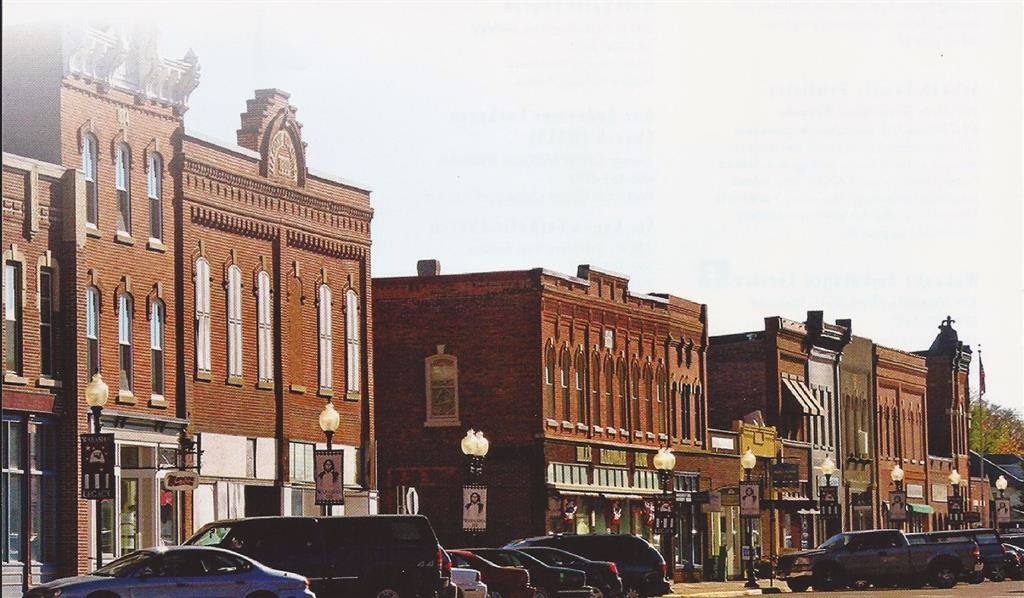
Like so many small towns, Wabasha has gone through its normal ebb and flow lifecycle.  Over the years, I’ve seen storefronts boarded up and stagnation take the place of progress. I remember over-hearing the infamous old men in the coffee shop complaining about their dying main street. Many of the old farmers weren’t able to see beyond their own acreage and some of the city elders only saw the downturn as the normal course of events.  Of course, their answer was always, more or less, to wait for something to happen.  But it seldom did on its own.

Fortunately, there were a few visionaries in town who had other ideas.  These were forward thinking folks who had taken a different outlook on the old place. Townsfolk who believed there was a future in that old river town once again.


It was one woman who had a vision of a place downtown where townsfolk and visitors alike could see eagles up close and learn about their habitat.  This one woman who through hard work and perseverance over several years was able to attract enough money to build the National Eagle Center. It is now a world-renowned museum and interpretive center dedicated to the eagle and other wild-life indigenous to the Upper Mississippi River watershed. It attracts thousands of visitors each month year round.


Lark Toys was recently voted ‘the best toy store in Minnesota.’  It has a full-scale carousel with hand-carved animals in the middle of its shop and mini-golf out back.


There are a slew of new restaurants in town, loft-style apartments and guest quarters over the downtown stores. In the wintertime the Coffee Mill Ski and Snowboard Resort caters to locals and tourists alike. One of my favorite stops is the Eagle’s Nest coffee shop which used to be an old garage. Talk about local flavor.

There are summer concerts ‘under the bridge’ and SeptOberfest, which runs from mid-September through October and draws visitors from around the country for juried craft boutiques, German food and fun activities for everyone.

Wabasha is on the move again.  But we’re now watching it from the sidelines.


Over the decades, our road trip south morphed into just my wife and I driving down those familiar miles of corn and wheat and milk cows. Gradually we moved from visiting the family farm to a house in town.  Finally, it was just Wabasha as our destination and an assisted living facility for her mother.


Sharon’s old farm house is gone now. After one hundred and twenty years as home to just two farm families it was torn down when a new owner came along. A few pictures still capture the old place before progress and a bill of sale took it all away. The four Schumacher kids are gone now. One in particular led the charge away from the old homestead and their rural way of life.


It began with a Notre Dame nun named Sister Mary Richard. She told a promising freshman at St. Felix Catholic High School that there was another world beyond Wabasha’s city limits. She convinced this young woman that there was a college in her future and travel and a world far beyond her father’s 250 acres and the farm boy down the road.


My grandchildren never got to visit great grandpa’s farm.  They never went searching for feral cats in the out buildings or fed the piglets in the hog shed. They never scaled the barn loft and played hop-scotch across the hay bales stored up there. They never rode on great grandpa’s tractor or watched him bale hay.  But they might remember their Nana telling them it was a wonderful place for her to grow up.


They won’t remember Wabasha or witness its rebirth. By then they will be grown-ups themselves and through their parents focused attention, their Nana and Papa’s influence and their own pedigree they will most assuredly take their place on the worlds stage.


At some point they’ll revisit the Schumacher family farm if only through old photographs and vapid memories. They’ll probably be regaled with tales of Wabasha, good and old. It’ll become an integral part of their heritage and much like old family tales handed down through the generations it will provide a glance into their past.

That’s what we do for our grandchildren; leave a legacy of our past and hopefully directions for their future.


Tuesday, January 6, 2015

Driven from Within


Where does motivation come from?

I have my own theories. In fact, they’re pretty deeply entrenched ideas of how and why some folks become motivated and others spend most of their lives just floating along.


It’s a bit of an obsession with me. I wasn’t cognizant of that fact until I got into writing on a full time basis. That theme of ‘being hungry’ has permeated a lot of my writing. The desire for more, for something else, something better has crept into two of my books “Love in the A Shau” and “Debris.” Both novels feature hungry young men determined to make a success of themselves. It’s a theme I can relate to and a vision quest I don’t ever see ending.

Let’s face it. We’re only here on earth for a brief period of time. Why wouldn’t we want to make the very most out of every minute of our existence? Why wouldn’t we want to do something with our lives that was worthwhile, satisfying and hopefully of benefit to others? And more importantly, why wouldn’t we want the same for our own children and grandchildren?


But anything worth doing is going to require some kind of sacrifice. Nothing comes easy…at least for most of us. When you’re born at the bottom then anything above that looks pretty good. When you have nothing growing up then you don’t long for those vapid pleasures that don’t amount to a hill of beans in the overall scheme of living. Growing up with the basics gives one a real appreciation for the simpler things of life.

That doesn’t mean you don’t want more. It simply means you appreciate the basic values of your own existence and can realistically grasp the intrinsic appeal of other things beyond your reach. There is value in being raised with a focus on the fundamentals of living and a scarcity of those extraneous distractions of wealth.

It’s not always easy being born rich. The three generation theory has been around for a long time. Among other monikers, it’s been called shirtsleeves to shirtsleeves in three generations.

Based on fact and some fiction, the theory simply asserts that most businesses don’t survive beyond the third generation of owners. Grandpa starts the business. His son takes over and continues for a time. But by the time a third generation is ready to step up to the plate, the discipline and hunger for success has been muted and gutted for all intents and purposes.

And it’s hardly unique to this country. In China, it’s called rice paddy to rice paddy. In Italy, it’s called cobbler to cobbler. In Ireland, it’s called clogs to clogs.

Being born poor and hungry can be a strong motivator for the taste of success. But what if your kids aren’t growing up poor like you were? What if they’ve had a lot of advantages simply because that’s what their parents (your own kids) want them to have? Do we deny them opportunities to travel, read a lot, go to a good school or have other life experiences we could never dream of when we were growing up? I think not.

Inherent in my personality is a deep-seated prejudice about giving kids ‘everything’ simply because their parents can afford it. I think there are distinct disadvantages of being raised a rich environment. And we all know who ‘they’ are. Back in high school, they were all gathered around the ‘most popular’ table in the cafeteria. Their descendants are still there today.

So where’s the balance between giving your kids or grandkids every opportunity you can to enrich their lives and still raise them as responsible, respectable and appreciative citizens of the world?

I certainly don’t have all the answers as to how to motivate young people nowadays especially my own grandchildren. The best advice I could probably give my own kids is to lead by example. To reward their own children’s efforts and not necessarily their success. And to remind their kids that practice makes for opportunities.


I didn’t become a writer in my advanced age because I wanted to.  I’m not writing because I have nothing else to do. I’m not writing because it makes me feel important. What I try to explain to these well-meaning folks who ask why I do it…is that I have no choice. This isn’t something that I can play with occasionally when the mood strikes. This is something that I have to do.

The writer in me has to get involved in my character’s lives. I have to travel back out west occasionally and I have to muddle around the under-belly of Palm Springs when the time comes. I have to do what I do because I was born hungry and still am today. I hope to stay hungry for the rest of my life.


In past blogs, I’ve commented that I want my grandchildren to ‘be hungry.’ Thus far, I think they’re developing a pretty healthy appetite for more. Hopefully at some point in their young lives, they’ll come to understand that old adage as I did a long time ago.

That the harder they work, the luckier they might become.