Tuesday, February 4, 2020

Digging Through the Bones


Retirement communities like those in the Coachella Valley have always been a little different than your average homestead. While most neighborhoods around any town have a reasonable number of deaths each month, here it’s a bit different. The more older folks around, the more that are likely to pass away any month of the year. Then the elephant in the room has always been: ‘What happens when?’ The reality here is that an above average number of retirees get old and die in place each month. What happens then to their lifetime of collected ‘things?’


Unique to Palm Springs and perhaps a few other retirement areas is our preponderance of consignment stores, Goodwill, thrift stores and estate sales; all meant to clean out the remnants of past residents. As a friend of mine likes to say upon hearing the sound of an ambulance. “There goes another condo for sale!”

I assume it’s the same in parts of Florida, Arizona, and other warm winter locales. The circle of life comes around and starts all over again. Newly purchased homes and condos are often furnished with the bones of sold off condos. Children of the deceased usually come into town with one goal in mind. Their objective is quite simply to empty their parent’s home, either sell off the furnishings or get them to a consignment store ASAP and leave town as quickly as they arrived.


The Coachella Valley has a wide variety of resale opportunities. Locally, a chain called ‘Revivals’ competes with other thrift stories such as Angel View and Goodwill. There are professional resale establishments like The Estate Company and (my wife’s favorite) Misty’s. There are probably dozens and dozens of smaller shops all collecting and catering to specialty items for resale. Then there are the many estate and garage sales meant to strip a house of any furnishings in as little time as possible.


In the field, the competition doesn’t stop at the door. There are professional bargain hunters who treat estate sales, garage sales and consignment stores as their full time buy and swap or resell profession. What’s left are the bargain hunters who are always on the lookout for a deal.


For some folks like myself, it’s a surreal experience scrounging through someone’s home after they have passed or gone to a nursing home. While it can sometimes border on the morbid, it is always a somber yet fascinating trip back in time. It’s like peeling away the life story of a person, revealing beneath the layer of dust and corner dust bunnies a glimpse into their daily lives. Old furnishings, paintings, appliances, records, tools, magazines, CDs and DVDs all tell a tale of their past life.


Last year, we went to the Hearst Estate sale (the grandchildren of William Randolph Hearst) and last week it was an estate sale conducted by the state of California through a broker. Both must have had fascinating tales to tell.

There can be bargains galore if you’re in the right place at the right time and the price is right. Sharon has collected, over the years, wonderful items for our home. She has found frames for her paintings and crystal and china for her collection. I’ve found old books that were ideal for research material for my novels or just a great read.

Moving amid the casual shoppers are the serious bargain hunters. These are folks on the lower end of the economic spectrum for whom garage sales and estate sales mean they can buy items they would never be able to afford otherwise. Furniture, old and comfortable, is often relegated to the poorest of shoppers.


Around here, especially in season, it’s the great circle of possessions passed on from one generation to the next. It’s digging through the bones of the deceased to build a new foundation for the living. For the serious and casual shopper alike, consignment is not a dirty word. It’s bargain hunting, great finds and surprises every time the garage door opens.

Tuesday, January 28, 2020

Trans Con


One of my fantasies, and trust me there have been many, has been to ride my bicycle across the United States. In biking jargon such a journey is called a Trans Con which is short for a Transcontinental Bike Ride. Therefore, about ten plus years ago I wrote a screenplay based on that simple premise.


I based my screenplay on a number of books I had read from individuals who had the grit, determination and energy to do just such a bike ride. Then there was my own personal experience of doing the TRAM (The Ride Across Minnesota) two years in a row. Those cycling books and my own experiences inspired me to write the movie.  I thought if I can’t do it myself, perhaps the next best thing would be to write a story about just such a life-changing journey.


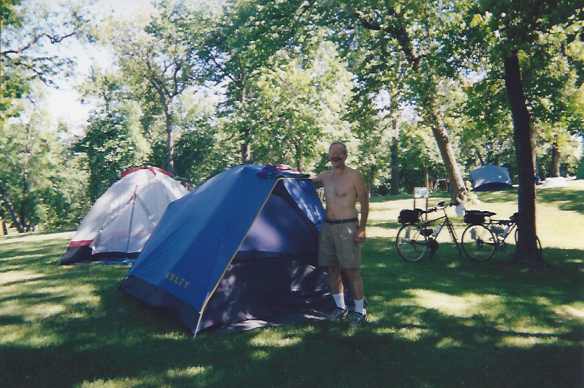
TRAM, the ride across Minnesota, is a week-long event held every year in July. When I did it back in 2004 and 2005, riders started on the border of South Dakota. After acclimating to our first night sleeping in a tent on hard ground and a port-a-potty half a block away, we were off and biking. The first day was usually a leisurely ride of fifty or so miles. There were lunch breaks along the way and no time schedule to adhere to. It meant riding, sight-seeing, visiting among various other groups and solitary time thinking about our sore backs, weak knees and the keg at the end of the day. We all adjusted to the routine quickly.


Then for the next seven days, we would average sixty to seventy-five miles per day crossing the state. We quickly got used to sleeping in our tents at night, riding in all kinds of weather; rain and wind and blistering sun. We sometimes drank ourselves silly at night in some small town bar overrun with dirty, thirsty bikers and were up the next day before dawn to do all over again.


Brian rode with me on the second ride, building up memories we both share to this day. Ah, but I was a younger man back then. Time changes a lot of things including my ability to do such a ride again.

Now it seems even the title of my screenplay has been corrupted by time.

In our ever-changing world of swirling, conflicting, and always-evolving social and cultural norms - there now exists a precedent that I will probably have to change the title of my movie. Recently, my editor pointed out that in today’s PC-laced world of ‘let’s not offend anyone, anywhere, anyhow, ‘Trans Con’ would probably be translated into ‘transgender convention’ just like Comic Con, etc. As open-minded as I see myself, that would probably be more than a little misleading for my intended audience.


So the title has been changed from ‘Trans Con’ to ‘Transcontinental.’  Now I’m pondering my next step in the chain of events that must take place in order for my script to come to life. One step is to actively market it and seek producers who might share my own vision of this story.

Making a feature film is a daunting task. Even without major investors, a production crew and actors who can carry their weight, producing movies is a time consuming and challenging task. Even more so for a novice such as myself.


Over the last twenty plus years, with the of advent of digital technologies, there have been many new avenues that have opened up to hundreds if not thousands of wanna-be film makers who now have the tools and knowledge to put a basic film together. While the charm and appeal of independent film-making hasn’t waned over the years, film distribution channels have been changing on almost a monthly basis.

Film festivals were once the gateway to acknowledgement of a job well done and possibly some kind of distribution deal. There was always the ever-hopeful wish for Hollywood’s possible notice. That is no longer true. Sundance has gone Hollywood and the proliferation of film festivals across the country and the world has diluted the impact that any one film festival might have on the successful introduction of a new film.

Nevertheless, filmmakers around the world persist in trying to make their films and distribute them. For me, it’s more than simply a long shot. There are other plays and novels screaming for my attention. My marketing efforts are sorely lacking and need a kick in the pants. Then there is the time and effort necessary to get such a project off the ground. In fact, it might be easier to just jump on a bike and do the ride myself.


For now, I’ll probably put off this particular project in lieu of several plays that show more immediate promise. Or take a long bike just to clear my mind…in hopes of meeting a Hollywood producer along the way.

Tuesday, January 21, 2020

The Club


Cliques are a normal part of everyday life. They can be found in organizations of every size, shape and affiliation. Institutions, groups and gatherings often share the same pedigree. Back in the day, it was sandlot baseball and who got chosen to be on which team. In high school and college, it was those thinly veiled popularity contests within clubs and classes. It was any collection of the ‘in people’ who felt they were above the rest of us peons. We all knew who they were and so did they.


I guess the common denominator among those club members was their like-mindedness to the exclusion of everyone else. After sixteen years of academic game-playing, I thought I was done with that narrow-minded, sometimes contrived notion that their way was the only way. But I was wrong. They say that education, politics and the arts all seem to favor the ‘chosen ones’ above the rest of us. In other words, politics rules the roost. Certainly, the gatekeepers in those fields feel that way.


In my ongoing search for new venues and markets for my plays and novels, I keep running into private clubs that masqueraded as theatrical venues, writing groups, neighborhood organizations and the like. It’s almost as if I’m back in high school and once again I’m on the outside, looking in. But even at this stage of my life, I’m still not willing to do anything to be on ‘the inside’ like all the popular kids in school. In other words, most of the time I’m not willing to ‘play their game.’

One way to get around or combat this silliness is to know who the real players are and to ask myself if I’m willing to play ball with them. It’s analyzing ‘stated’ objectives and goals as opposed to the real objectives and goals. Then it’s deciding just how far I want to go to reach my own objectives.


 I was once told that making changes in the world of education is like steering the Queen Mary. It is nearly impossible unless all or most of the university’s colleges, departments, and faculty committees collectively buy into the changes. I don’t think it is much different with these aforementioned theatrical clubs and venues.

Like the TSA agent at the airport who controls your life in the security line for a brief period, usually the artistic directors hold the reins of their venue. It’s their turf, their kingdom and their domain. You’re only passing through unless you’re already a part of the club.

Boards and committees aside, the Program Chair, Artistic Director, or Director decide which plays get produced and whose theatrical work they will herald. This is their ‘real world’ where they reign supreme. Outsiders are simply interlopers who may or may not be welcomed into the club. Some are honest about it and upfront as to their taste in material. Others feign interest in new material but have already decided what meets their standards and critical best.

I had another turn down recently. But this one was different. Usually it’s the absence of a response to my inquiry that broadcasts loudly and clearly little interest in my work. I never get to find out why I wasn’t admitted into the club. This latest rejection came from a large senior living complex where their Performing Arts group puts on a play or two each year.


I had corresponded for several months with their VP of plays. She seemed very interested in meeting me and reading my scripts.  I felt confident I had a couple of plays that would meet their theatrical standards and would be a fun evening out for their residents.  We met over coffee. The meeting went well and she invited me to send her some scripts which I did that evening. Overall, it looked very promising.

The Vice President of Programming thought differently. She turned down both plays flat. When I asked for an explanation she didn’t hold back. I appreciated that. She was honest and clear about what she liked and didn’t like. She was firm but professional and she treated me with respect.

She certainly felt her reasons were sufficient to reject my plays. I personally thought her reasoning was a bit askew but that didn’t matter. She held the ball and it was her ball game. Now I know what she is looking for and might have something for her in the future. Or not.

I fear she is perhaps looking for that ‘find of the century’ in terms of theatrical entertainment. Some new approach to the theater that would make her a somebody in her tiny theatrical world. Never the less, she was honest and forthright unlike a lot of her counterparts.

I had a boss once who loved to exclaim: “If you take the money and the title, you should do the job.” She did and I respect her for that.


So my quest goes on every time I approach some gatekeeper about my plays. Hopefully, I’ve done my homework upfront. I should know what their audience makeup is like, what kind of plays they’re performing and how they see themselves in the wild and woolly, crazy and confusing world of community theater and art houses.

I’m trying to learn the game as much as I can as even it swirls and changes direction all around me. There are the ever-current trends and philosophies, financial considerations, political gamesmanship and the ever-present theatrical intrigue that permeates this business.

And I thought television was a crazy business.