Showing posts with label mid-century modern. Show all posts

Tuesday, April 5, 2022

Over The Top

After a hiatus of two years because of COVID-19, the annual Palm Springs Modernism neighborhood tours are back. Sharon and I have been docents for these home tours since they began. It’s a great way for us to see select Indian Canyon homes and enjoy their artistic venturing into new home styles.


Modernism Week is a signature event held every February and very unique to Palm Springs. It attracts thousands of modern architecture lovers from all over the country and the world. There are a host of events to showcase and highlight the very best of modernism designs and trends. There are art fairs, a modernism yard sale, vintage car show, lectures and films on historical Palm Springs architecture, as well as many events at the convention center. One of the highlights of the week are the neighborhood home tours.

Beginning in the mid-40s, architects originated a design movement specific to the greater Palm Springs area. It became known as Desert Modern. Their buildings featured groundbreaking techniques such as post-and-beam supports, floor-to-ceiling glass walls and a wide array of colors to match the surrounding mountains and desert. Now famous architects such as William Krisel, E. Stewart Williams, Albert Frey, William F. Cody, Richard Neutra and Donald Wexler were among the masters of this design.

Our neighborhood was included in the home tours this year so Sharon and I once again volunteered to be docents. It was a great opportunity to meet more of our neighbors and peek in on the lives of the design-conscious, artsy-types who created these one-of-a-kind homes.

Most of the home owners are warm and wonderful folks, truly modest in their accomplishments and extremely welcoming to all their guests. A few are snobs without credentials who think they’ve hit a homerun from third base. We’ve been lucky to have had fun, accommodating home owners whenever we’ve been docents.

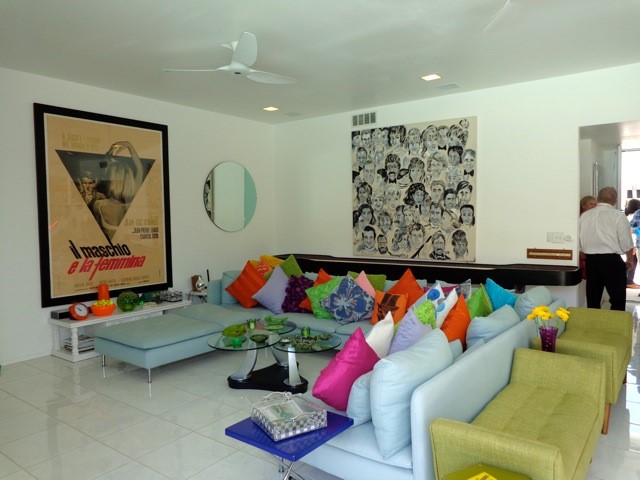
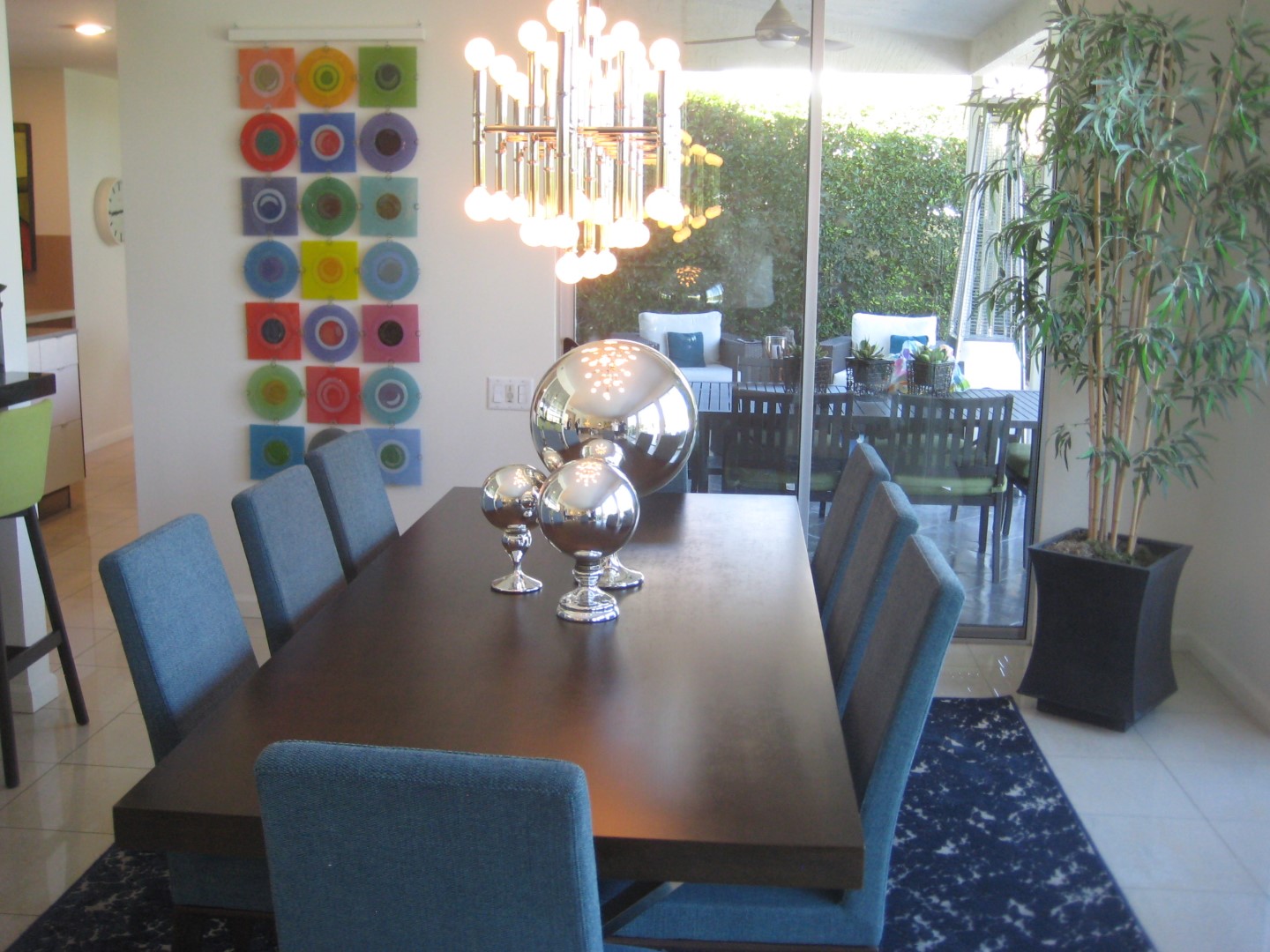
It was fascinating to see what had been done to these retro houses and how the other half lives. Most of the homes were owned by interior designers…no surprise there. Each was a designer’s delight. Stunning is not too strong a word to describe some of those settings.


The house where we were docents had been totally remodeled and was stunning in its décor. It was a fitting tribute to the glitz and glamor that many imagined was old Hollywood. Older visitors seemed genuinely interested in the tales of its past occupants. The newer ones just liked the mid-century design. So it goes in the land of fact and fiction, rumor and innuendo - but always a good story to tell.


Over the years, we’ve had the privilege to visit those homes most people would never see. I think it’s fair to say that most of these artistic palaces are ‘over the top.’ One particular home that Sharon still talks about had two complete kitchens and then a separate catering unit set up in the garage with oven, stove, microwave, frig, etc. Fair to say, the owners liked to entertain a lot.
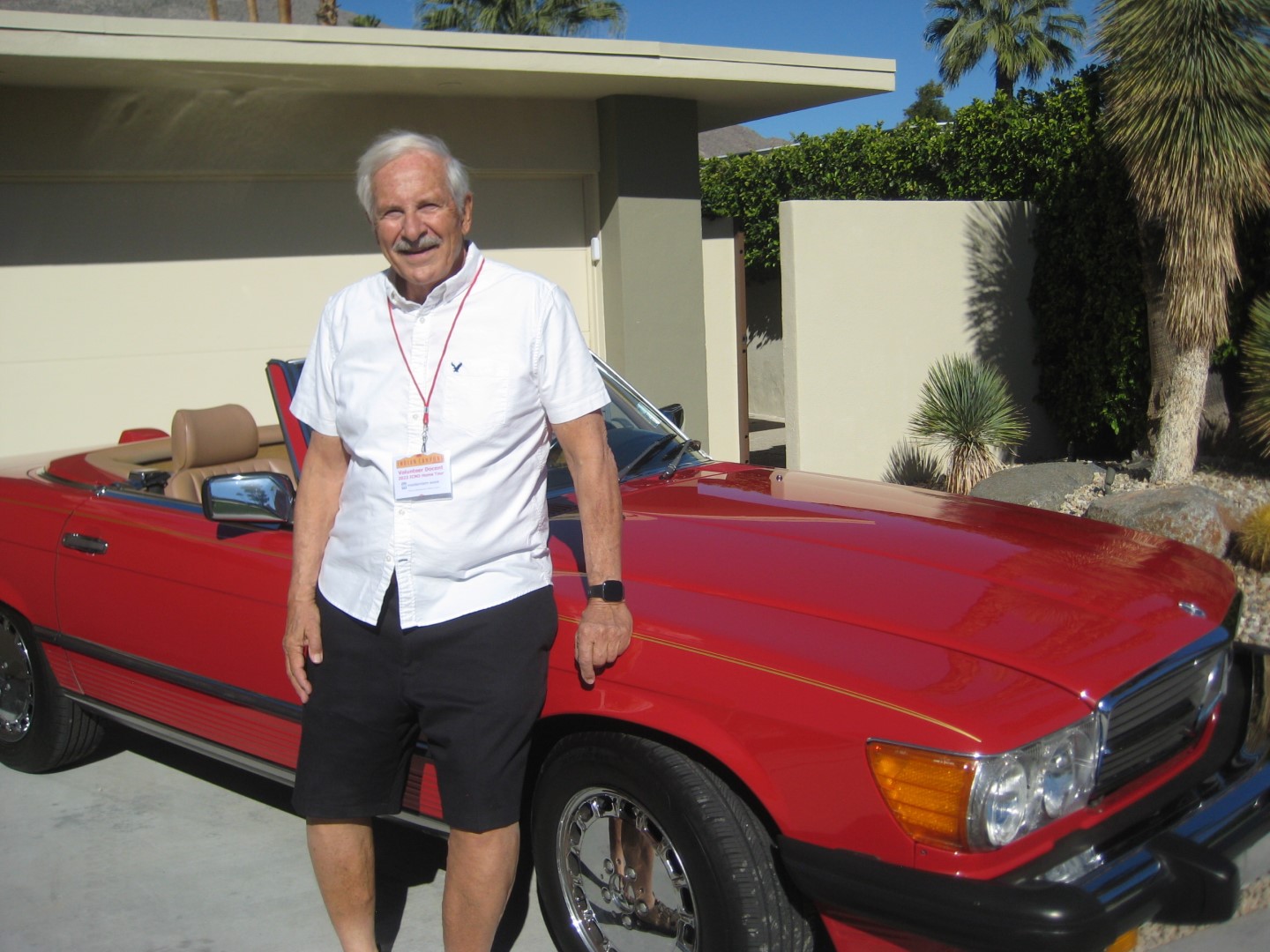

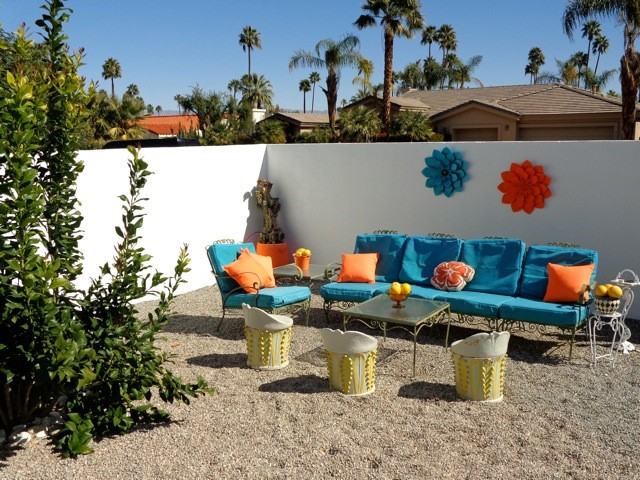
I took a lot of pictures of those six homes and thought it would be fun to share just a few of the images of the ‘lifestyle of the comfortable and accomplished.’

LIVING ROOMS


KITCHEN AREAS


BEDROOMS


OUTDOOR ENTERTAINMENT


Another home tour ended and we retreated to our more modest, comfortable sojourn in the desert. It’s certainly not ‘over the top’ nor Hollywood regency like most of those homes on the tour were. Instead, it’s a reflective habitat where Sharon can paint and I can write and we don’t have to worry about the newest in design challenges and keeping up with our neighbors down the block.

Tuesday, March 17, 2020

McM


Mid-century modern design was hot in the Coachella Valley back in the Forties and Fifties. It was seen as a cost efficient, unique style that lent itself well to the harsh desert environment. These mostly second homes were modern and attractive for weekend owners and visitors alike.


Beginning in the mid-40s, architects originated a design movement specific to the greater Palm Springs area. It became known as Desert Modern or McM (Mid-Century Modern.) Their buildings featured groundbreaking techniques such as post-and-beam supports, floor-to-ceiling glass walls and a wide array of colors to match the surrounding mountains and desert.


‘Palm Springs Modern’ became the catch phrase for anything and everything young and hip among the trend setters from L.A. and San Francisco. Hollywood embraced this self-serving, indulgent, narcissistic approach to self-realization. All was well with the world until reality came rumbling into the picture in the form of global tourism.

The burgeoning global tourism industry whisked annual vacationers, including many Hollywood stars, out of the country on jetliners bound for Europe and Asia. This mass deflection curtailed cross-country road trips and put resort destinations like Palm Springs and the Hawaiian Islands on the back burner.

By the mid-seventies, twenty years of population and construction booms had left Palm Springs exhausted and depleted. Proposition 13 did little to help the city’s finances. A building moratorium was declared and consequently the 70s became a period of no growth for Palm Springs.


While Palm Springs stagnated, down Valley communities like Rancho Mirage, Palm Desert, and Indian Wells offered building opportunities that Palm Springs no longer could. Young families and the wealthy moved east into gated communities and country clubs.


Palm Springs lay dormant and undisturbed for another twenty years until the mid-90s when interest in mid-century modern architecture and designed started to swell once again. The 1950s were reevaluated as a period that produced an explosion of ideas and a purity of design that has not been matched since.


Never one to miss an opportunity to blow its own horn, Palm Springs jumped on the McM bandwagon about ten years ago and has never looked back. Modernism Week became a signature event held every February in Palm Springs.


This year, it attracted over 150,000 modern architecture lovers from all over the country and the world. There were 350 plus events to showcase and highlight the very best of modernism designs and trends. There were art fairs, a modernism yard sale, vintage car show, lectures and films on historical Palm Springs architecture, as well as many events at the convention center. One of the highlights of the Week are the neighborhood home tours. Our Indian Canyon neighborhood was included as a part of this year’s home tours.


The historic Indian Canyons Neighborhood, originally known as the Canyon Country Club Estates, was built in south Palm Springs in the early 1960s. Developers created a variety of high-end homes and condominiums with famous architects like William Krisel, Stan Sackley and Charles DuBois among others. The homes stark lines and heavy furniture spoke of status and class among the Jewish upper crust of the coastal cities; their intended demographic.


The North Course was built in conjunction with a 1.5 million dollar stunning midcentury modern clubhouse designed by Donald Wexler and Richard Harrison. To make the opening of Canyon Country Club spectacular, Walt Disney, who owned several luxury homes built along the second fairway, donated a fountain that shot water into the sky from a floating lily pad.

In years past, Sharon and I had volunteered to be docents for these home tours of our neighbor-hood.


The home where we were docents, at 2,800 square feet, was built in 1966 by Harry Kelso. Its current owners purchased the home in 2017 and spent 16 months gutting the home and doing a complete remodel.


The home features a modern kitchen and all new windows and doors, including tall custom sliders which hide into pocket walls in the living room. It’s a smart home and owners can control the lighting, shades, music, HVAC, security, etc. remotely from almost anywhere.


It was a great opportunity to meet more of our neighbors and peek in on the lives of the design-conscious, artsy-types who created these one-of-a-kind homes in our South Palm Springs neighborhood. Those homes are as much a statement as anything else. They speak of great taste in design, opulence, class, and status.


Fortunately, my taste doesn’t lean toward mid-century modern architecture or eclectic furnishings. I’m too old-fashioned for a $10,000 sofa designed by some ancient Italian or a chair made out of Plexiglas. Give me a comfortable chair, a cup of coffee and mountains as my backdrop. That’s all I need.

Still, it’s fun to look.

Tuesday, June 18, 2019

Newest Club in Town


Fans of mid-century architecture are drawn to Palm Springs because of the plethora of original and redesigned mid-century homes here. It’s a ‘modernism’ mecca for design aficionados and those who want to return to the more simple times of the late 1940s and early 50s.

Since ‘Modernism Week’ began about ten years ago in Palm Springs, the legions of McM fans keeps growing and interest exploding. Yet there is a subtle truth lurking just below the surface of all of this excitement. The fact is that few can actually afford to live in one of those mid-century treasures…until now.


That real estate disparity is slowly changing with the refurbishing of an old trailer park, an extended land lease, and some imaginative architecture. Palm Canyon Mobile Club is a completely remodeled mobile home community with its newly-built ‘modern micro-homes in a not-so-tiny package.’ Homes start at around $115,000 for a one bedroom plus an average of $650 per month space rental. It’s one of the newest clubs in town for McM addicts.


I tell friends that there are three things to remember about real estate here in California. First, this is California real estate so it doesn’t have to make sense relative to the rest of the country. Secondly, this is Southern California real estate which means it can get even crazier than other parts of the state. Finally this is Palm Springs real estate which is a unique hybrid in itself. If you understand anything about the housing market, you could probably guess that California housing is an entirely different breed of animal.


In addition, studies have shown that the millennials’ demand for a new type of neighborhood has led to the emergence of ‘Urban Suburbs.’ Those are defined as high-density neighborhoods in suburban areas that share a number of urban qualities such as walkability and nearby amenities such as shopping, restaurants, etc. North Palm Springs is starting to attract this kind of development as well as other parts of the country too.

There is a new cluster of tiny homes being built outside of Atlanta. The Clarkston development will be the first neighborhood of homes under 500 square feet to be sold in Georgia. Other metro projects are to follow with 40 tiny homes being built in South Fulton and another in the Pinewood Forest in Fayetteville.


Creating new housing designs that complement the surroundings here is nothing new for Palm Springs. Beginning in the mid-40s, architects originated a design movement specific to the greater Palm Springs area. It became known as Desert Modern. Their buildings featured ground-breaking techniques such as post-and-beam supports, floor-to-ceiling glass walls and a wide array of colors to match the surrounding mountains and desert. These were homes meant for the very few who could afford them and their tony locations in the desert. Now one developer’s solution to that exclusivity lies in a century old model that’s been around for ages…the mobile home.


The Palm Canyon Mobile Club was originally built in the early 1960s. The location was ideal. It was close to shopping, restaurants & bars, and offered its residents some of the best mountains views around.  The park was one of the rare few to allow all ages, not just seniors.

In late 2016, the master lease for the park was purchased and the ground lease was extended 65 years, which provided security for the park's future. Now the developers are bringing a new vision to the Palm Springs Mobile Club with their own version of the tiny home.


The developer’s idea was to take your standard mobile home park and turn it into a desert enclave of tiny homes. They’ve taken the old reliable double-wide mobile home and turned one half of it into a tiny home. Of course, being Palm Springs it couldn’t be just any half of a double-wide. The developer and designers have used the cantilevered roofline as an architectural statement and designed amenities that both complement and enhance the main structure.


With nine foot ceilings throughout, plus clerestory windows and sliding glass doors, the homes are flooded with natural light. There are one and two bedroom homes, ranging in size from 600 to 900 feet. It’s single level living with full sized appliances and room for a washer and dryer. There are some private fenced yards, a lot of outdoor decks and select front porches.


The center of the community is "The Club," featuring a newly remodeled clubhouse; updated resort style pool area that includes an outdoor fire pit and lounge areas, plus barbecue area. A workout room, pool table, plus updated poolside bathrooms and sitting areas are part of the clubhouse features.


It may take some time to see if this new housing concept takes hold and portends more radical changes to mobile home parks throughout the Coachella Valley. Palm Springs has always had a wide variety of housing from single-family homes, duplexes, condominiums, cooperative housing, senior housing, mobile home parks, apartments, vacation rental properties, and VBROs.

Now tiny homes are edging their way into the marketplace. It will be interesting to see if they take hold and how price appreciation compares to other types of housing.

Only in Palm Springs.