Tuesday, March 1, 2022

Survival Guide to Everyday Living

There is a book I’d love to write but probably won’t. In reality, I don’t have the time, patience, or willingness to put it ahead of my other writing commitments. Unfortunately, I think it’s a book that many people need to read because it could be so relevant in today’s social, business and economic climate.


The idea behind the book came from my recent readings about the economic, political, and social upheavals that occurred in the past and are still going on today, not only in this country but worldwide.

The intertwinement and entanglements of business and political interests has been going on since the late sixties and early seventies. It’s an open secret that lobbyists weld an enormous power in Washington for the vested good of special interests and the moneyed elite. Generally speaking, it’s the middle class who gets the short end of the dollar stick in most of these transactions, arrangements and agreements made into law.


Even Norman Lear’s autobiography ‘This Too I Get to Experience’ touched on the same subject matter……short-sighted vision instead of long term perspective. Lear talks about a conversation he had with a Harvard professor who lamented ‘the most rapacious societal disease of our time: short-term thinking’.

The professor explained: “There will be a time very shortly when young people-very young people- will be looking into computer screens. They will be looking directly into screens, not to the side, so there will be no peripheral vision; they won’t be looking over the top, so they won’t see what’s ahead; they’ll be staring straight ahead into those screens, blind to everything ahead and around them.”


Money managers and financial product traders will be selling, buying, and swapping financial products around the world. With that narrow focus, like a horse with blinders, they will have more control and hold more power in those split seconds than we can today imagine. And all of it entirely focused on short-term gains.”


Back in 2008, the near collapse of our world-wide financial system, and Wall Street in particular, should have been a wakeup call for all Americans to pay more attention to their wallets and events happening around them. Unfortunately, not much seems to have changed over the ensuing years. Every day there are new financially-coated products, events, angles, schemes, and ‘can’t lose’ facades presented to the general public.


To that end, financial literacy and media literacy are two topics of interest that every American should acquaint themselves with. One of the best descriptions of financial literacy came from an internet site of the World Bank.

It reads as follows:

‘What is financial literacy all about, you may ask? Essentially, it is the ability to use one’s knowledge and skills to effectively manage financial resources, ideally for a lifetime of financial well-being. Indeed, financial literacy is something we all have to work on each day—it’s part of our ongoing education.


Despite being a relatively new field of study, financial literacy has become increasingly important for governments and citizens – without it there can be broad implications for the economic health and stability of countries.


Here in Russia, the authorities are highly cognizant of this and thus partnered with the World Bank in 2011 to start implementation a project on financial literacy and education. Promoting responsible and rational financial behavior is one of the main goals of the project, along with establishing financial education infrastructure at federal and regional levels, increasing the accountability of financial services providers, designing a national strategy, raising awareness and strengthening institutional capacity and underlying business practices between consumers and financial services providers.


This project focuses primarily on improving the financial literacy of school-age children and college student. The idea being that they gain the modern required financial knowledge and awareness of financial instruments, which then they can bring home to their families, including seniors, and to the wider community.


Thanks to the project, financial literacy courses have been introduced in schools and universities, with training provided to teachers and tutors across the education system. By June 2018, over 20,000 university students and teachers from almost two-thirds of Russia’s regions had completed training courses in financial literacy offered by the project.


Organized with support from the project, the National Savings Week for Adults and the National Week of Financial Literacy for Children and Youth have gained significant traction in 2018 – the latter engaging over 2.5 million children and teenagers who participated in around 25,400 events across Russia.


To support these goals, Russia’s Ministry of Finance and the Central Bank approved in 2017 the National Strategy for Financial Literacy for 2017-2023, and launched its Implementation Road Map.’  *


Media literacy, on the other hand, is using common sense instead of letting some so-called journalist do it for you. A good definition can be found at Medialit.org.


It reads as follows:

‘What is important to understand is that media literacy is not about "protecting" kids from unwanted messages. Although some groups urge families to just turn the TV off, the fact is, media are so ingrained in our cultural milieu that even if you turn off the set, you still cannot escape today's media culture. Media no longer just influence our culture. They ARE our culture.

Media literacy, therefore, is about helping students become competent, critical, and literate in all media forms so that they control the interpretation of what they see or hear rather than letting the interpretation control them.

To become media literate is not to memorize facts or statistics about the media, but rather to learn to raise the right questions about what you are watching, reading, or listening to. Len Masterman, the acclaimed author of Teaching the Media, calls it "critical autonomy" or the ability to think for oneself.

Without this fundamental ability, an individual cannot have full dignity as a human person or exercise citizenship in a democratic society where to be a citizen is to both understand and contribute to the debates of the time.

from Literacy in a Media Age: An Overview and Orientation Guide to Media LIteracy Education

It simply comes down to that old, worn, yet so true cliché: Let the buyer beware. We all have the responsibility to listen and learn for ourselves instead of letting someone else do it for us. To use common sense instead of group-think and to forge our own path to enlightenment instead of following the crowd.


I recently touched on a similar subject matter in a blog entitled: ‘Don’t Touch my Avatar’. Today’s financial and media worlds are full of tall tales of quick riches and absolutes in the area of truth. We have to dig through the everyday floss and moss to find the reality behind many of those facades masquerading as the truth.

·       *Definition of financial literacy – World Bank web site

·       *Medialit.org


Tuesday, February 22, 2022

Up, Down, or Level

Here we go again, another season in the desert. Only third time is still no charm. It’s just a repeat of the last two seasons living with Covid. The names have changed from Delta to Omicron but the results are the same. The ever-present hospital crisis, labor shortages, food chain disruptions, a lack of social gatherings and old habits now curtailed because of the pandemic.

Beginning in late fall and early winter of 2019, Sharon and I could all feel that something was going on. Despite the half-hearted reassurances from the government and confusion on the part of the media, it was obvious that things were amiss both abroad and probably in our own back-yard.

Fast forward just a couple of months and a world-wide pandemic was upon us. After a couple of months basically sequestered at home, we grabbed a Suburban rental and headed back to Minnesota.


After a limited summer in Minnesota, our return to the Valley was delayed by a surprise illness. Sharon and I didn’t get back to Palm Springs until early December of 2020 instead of our normal November return. That abbreviated season was limited in our social engagements, work-out venues, and a return to ‘so-called’ normal activities.

The summer of 2021 (seemingly) promised hope with its diminishing returns of infections. Then chaos returned with a vengeance and it was deja-vu all over again with a new virus named Omicron.


Over the years, a lot has changed in the Valley and many things have stayed the same. We’ve been here during some horrific wind storms, infrequent torrential rainstorms, too many minor earthquakes to count, social changes, and economic ups and down.

I could probably trace my time in the desert by the number of books, blogs and plays written during the winter months spent here. But there’s another equation that is just as pertinent. That would be the activities that used to be a big part of our life while residing here. Over time, a lot of those same organizations, events and past patterns of behavior have changed, evolved or adapted to the times.


There were a number of mountain trails I’ve hiked in the past and the tram road challenge I’ve tried to traverse. Time, age and a lack of exercise have narrowed that list down to just a few now. I could review the many gyms I’ve used for periods of a year or more. Covid shut down a lot of those places for extended periods of time. Now my own hesitancy of entering small enclosed spaces has kept me away from all of them.


The Palm Springs Writers Guild has gone through many different mutations; changing leadership, members, activities and purpose. I joined several writers critique groups over the years and participated in almost all of their book fairs. Sharon even taught selling techniques to members before the book fairs. Like any organization, that one has evolved and changed with the times.


Script2stage2Screen, a theatrical venue in the desert, provided me a wonderful opportunity to stage manage a number of their scripted plays and even had one of my own (Polly’s Amorous Adventures) produced there. That also closed down during the pandemic and only recently took tiny steps toward reopening.


I was on the board of the Indian Canyon Neighborhood Organization for several years. Sharon and I were docents on a number of their home tours during Modernism Week and even wrangled balloons during the Annual Palm Springs Winter Parade. Now their monthly and annual meetings are all on Zoom.


Sharon began her new painting career in NordeEast Minneapolis at the old NKB, Northrup King building, several years ago. She brought that enthusiasm and continuing growth to the desert and set up our garage as her new studio in the shade.


As mixed and varied as our experiences have been, I think it’s fair to say they’ve never been down or level but always, to some degree, a constant refinement, improvement, and adaptive stance taken. Unlike a lot of other retired folks here in the desert, I don’t think we’ve ever plateaued or lessened our involvement here.


Twenty years is a long time to observe other individuals and couples who reside here part-time or all year round. It doesn’t take much detective work to notice that some folks have slowed down and now totally embraced their retirement lifestyle while others have definitely declined mentally and health-wise over the years. If you’re going to slow down and ‘take it easy’ then this is definitely a good place to do just that.

Granted, the desert doesn’t hold an ace in terms of comfortable places to slow down. I have a number of friends and acquaintances who have moved into Over Fifty-five Senior complexes or straight up Senior living environments. To a person, they’ve embraced this new stage of life for themselves.


I’ve had a rather productive period during our third restricted season in the desert. A plethora of new blogs were published, a new novella, a new children’s book and five plays revised and rewritten. Several play rejections have simply steeled my determination to continue plowing ahead in creating and marketing new product.

I guess I’m still of the opinion that unless you keep moving forward; age, time, and the universe just keeps conspiring to slow you down. As the clichés go, a body in motion is a body still alive. An inquiring mind is still an inquisitive mind and a desire to improve is still a goal worth pursuing.

Level and down are not viable options if you want to outpace the facts of life. It’s an accelerating and rising life that makes the tired bones and sore joints worth getting up every morning.

Tuesday, February 15, 2022

Waleed Rising

It started way back when with Tarzan, Sir Lancelot, and the Battle of the Little Big Horn. While in my pre-teens, I thought I wanted to be an artist.


So, with images I could copy or pictures in my mind, I took colored ink pens and began to draw. The results weren’t bad nor were they particularly good. Several comic books and many draw-ings later, my mind wandered off toward other cerebral distractions. I thought perhaps I’d try drawing words on paper instead of cartoon images.

Now fast forward some fifty or so years and another kind of image came back to my mind. This time it was a skinny hippo and he had a story to tell.


Waleed came into focus last fall. But truth be told, he’d been hiding in the shadows of my mind for a very long time. The exact origin of the story line has long since been lost among the crags of my foggy memory. I do know it started out about fifteen years ago.

It was a rather simple story of a hippopotamus that wasn’t like all the other hippos. Waleed was skinny and feeling very unsure of himself because of his slender physic instead of the robust form of the other hippos. Once planted in my brain, the storyline began to grow and take shape. Without a lot of fanfare and deep thought, the story evolved into a children’s moral tale or fable with a wise old fish, indifferent fellow hippos and one sad little guy.


Years before, I had initially worked with an illustrator who created one cover illustration which I loved. Unfortunately over the ensuing months, nothing much happened in terms of creating this children’s story. So eventually we terminated our effort to produce the tale of a skinny hippo.

Fast forward to last summer and a drought in my writing projects. My editor, Vida, suggested we revisit my children’s story about the little hippo that couldn’t. Only this time, we went the internet route and found five web sites just for freelancers of every ilk and talent. It was a veritable wishing well of illustrations of every form, function, style, technique, and skill level.


Initially, Vida and I found 92 different illustrators over five web sites to review. That, in turn, was whittled down to four I really liked. Finally, we settled on two artists who seemed to meet my criteria of a drawing of a cute and cuddly little skinny hippo.


Waleed, in Swahili, means ‘he who hides.’ That, in turn, seemed the perfect male name that best described someone who was an introvert and afraid of his own shadow. The name matched perfectly my loveable tiny hippopotamus.

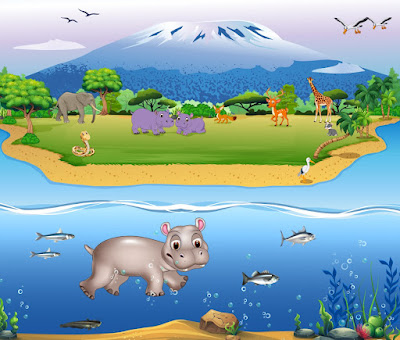
I also wanted it to be authentic in that I wanted to place the story in a real river (the Pangani River) near a real area (the savanna near Mount Kilimanjaro) with real animals (elephants, giraffes, etc.) on the plains and with real fish (Jipe Tilapia and the Oreochromis Tilapia) in the river.

The final winner was an artist out of Bangladesh who goes by the artist’s name of Shamima. Her drawing of little Waleed won my heart over.


After deciding on Shamima, we asked for a fully illustrated panel that showed Waleed, his fellow hippos, an African background setting and other animals. That panel came back and then we asked for the full set of twelve panels to tell our story.


The first set of panels (illustrations) were close to perfect with just a small number of changes and revisions needed. The second set of revisions came back and we were off to the races.


I made several passes at editing my original text to try to get it down to a child’s reading level. Then we had to figure out just what ages it might be most appropriate for. Last fall, Sharon and I had attended the Minnesota Children’s Book Festival in Red Wing and got a lot of great ideas for children’s books.

We studied book sizes, placement of text, full panel drawings, half page drawings, isolated images on the page, multiple images on one page and other assorted techniques to drive the colorful impressions home. We also decided that the accompanying text would be more interesting if it were in both English and Swahili, the language of places where hippos reside - like Tanzania. So, we found a Kenyan translator by the name of Hannah and we were off to the language races.

The translations are quite interesting.

Waleed, the Skinny Hippo  |  Waleed, Kiboko Mwembamba

A bilingual fable in English and Swahili  |  Hadithi ya lugha mbili katika Kiingereza na Kiswahili

My two cohorts in this project are, quite literally, worlds apart.

Illustrator:  Jubayda Sagor (Shamima)

Shamima is an expert children’s book illustrator and digital artist. She lives in Bangladesh.

Translator:  Hannah Kwirikia

Hannah Kwirikia is a native Swahili speaker and translator who lives in Kenya.

The building blocks are in order. Now the real job begins of designing and creating this book for children. It will call for a totally different marketing approach than from my adult novels and plays. The packaging, the marketing, and distribution will be a whole new ball game.

There’s already some thought given to future stories of Waleed, the skinny hippo. Our world offers up numerous moral tales for children. Although most adults think they’ve got all the answers already, I think there are truisms and honest facts about life that children, along with many adults, could well be reminded of.

Waleed just might be the little hippo that shows all of us a new way of looking at life.