Showing posts with label west bank. Show all posts

Tuesday, September 29, 2026

Ode to a Broken-Down Palace

What goes around, comes around or so they say. For me, it was an invitation to join a poetry reading at a local bookstore in downtown Saint Paul. Subtext Books was hosting a poetry reading by Greg Watson and Patrick Cabello Hansel, two well-known and respected poets in the Twin Cities and regionally. I was asked to join as a third member.

It seemed a fitting ‘coming home’ after more than eighteen years of wandering the vernacular jungle. Beginning in a rundown hovel in the mid-70s, the exploration of the written word in its many forms had begun as a second life/side gig/closet passion and held me fast for so many years. Poetry and songwriting had become my moniker; that hovel, my writers’ nest.


Everyone wants someplace to call home. For me, it began in a house on Randolph Avenue where the trials and tribulations of youth were hidden in the stale air still lingering there. Then, after living in Europe after college, I was looking for a place to crash while I waited for my life to take some semblance of order.


Finding that sad old relic of better times on University Avenue marked the beginning of yet another world I was about to enter. I joined a cauldron of cast-offs and bottom feeders which accurately reflected where my head was at and where I was going…in no particular order. Disheveled, messy, chaotic and rudderless yet always angling for a better direction.


The Twin Cities has a long history of nesting enclaves of immigrant families and other bottom feeders who haven’t yet assimilated into modern day society. This apartment building was just such a place. It was Swedes Hollow, the Bohemian Flats, Little Italy and the West Side Flats all wrapped up in a half-dozen, squalid, cut-up apartments. As time progressed, that area around the University of Minnesota, especially around Dinky Town and the West Bank, became my own microscopic version of Greenwich Village.

And as the song lyrics go ‘most of my changes were there.’


It’s become part of my lexicon now. Not because of some foolish notion that it represented my ‘glory days’ or the ‘best years of my life.’ And hopefully not because it might sound like the musings of an old man. It was, instead, a moment in time long since gone but still captured in a few faded photographs and dusty vinyl jackets which help poke probing fingers of inquiry into that slowly fading memory bank cached inside my head. For those places and people and events all helped define who and what I have become…and strive to be.


From 1967 through 1970, the Palace became my safe abode where I could spill out my thoughts and ideas on paper without the threat of criticism. That relic of better times came to represent, among other things, all those individuals I knew and loved and lost touch with over the years. It was the silly and foolish things I did and thought. It was all those wild aspirations and stumbles I took in the right direction. It was accidents that didn’t happen and a few that did. It was all those seemingly innocuous events that changed my life and laid the groundwork for a lifetime of story-telling in one form or another.

So, while some oldsters may lament their sometimes checkered past or lost years, I choose to embrace them as a reflective exercise. While some may scowl at rekindling the past by saying ‘it’s best not to look back’ and ‘let the past be,’ it is for me very personal.  It was a time of my ‘lost years.’


The building had been chopped-up, divided and then subdivided into probably illegal apartments for whoever could afford the cheap rent. There was a group of graduate students from Pakistan below me and odd assortments of humanity in the other units who seemed to come and go with the seasons. The overall mantra of the place seemed to be “Say Hi,” don’t ask questions and ignore what’s going on unless you think the place might burn down. I thought of my place as bohemian chic. Visitors might have had a different impression. Shortly after I moved out, they tore the building down and put up a parking lot (seriously).

After a couple of months working/writing at the Public Health Department, I ventured down Como Avenue to the studios of KTCA. They weren’t hiring at the time but they were glad to use my volunteer services in the evenings. I learned the craft of television from the ground up. It became my first real job where I never felt like I was working.

As significant as that old television building was in my life, even more prominent was a bar on the West Bank. That den of ear-busting music, sweet-smelling haze and questionable characters figured prominently in one of my first novels entitled “Love in the A Shau.” On the surface the Triangle Bar was a rundown three-two joint with intoxicating music, cheap beer and loud crowds that came to see, be seen or just smoke a joint in the corner. Beneath the surface it was my baptism into another life.

During its heyday, the Triangle Bar became the flash point for a burgeoning music scene centered on the West Bank. Since they didn’t card, the bar attracted a lot of U of M students. I’m guessing the term ‘jail bait’ was first coined there.

But beneath that surface melting pot of hippies, junkies, college drop-outs, undercover cops and other assorted flotsam from civilization came a wonderful collection of lost souls and seekers. Every night brought another stimulating conversation with some colorful character who usually gave a false last name, lied about their background but presented fascinating suppositions on life and love and war and college and our future in general. It was a true college education outside of the classroom.


They’re all gone now. Removed like push pins off a bulletin board of icons long since dis-appeared. My apartment on the avenue, the Triangle Bar, the old Public Health Department building on campus, crumbling Dinky Town, Newman Center with its folk music, the Grandview Theater and its foreign films and a dozen other sad-eyed structures all razed by a bulldozer called time.


So, I guess I’ve come full circle now. Re-reading poems that were written more than fifty years ago. It's still a sometimes conflicting confluence of attitude and interest, circumstance and focus, goals and objectives. Back to crafting thoughts, ideas, emotions and moods out of jumbled words tied together with a string of imagination. The focus is on song lyrics, really poetry in disguise, that I’m trying to capture once again.


Interestingly enough, the grandkids came down for this poetry reading, listening to Papa reminiscing and recollecting when I was just a little older than them. One generation sharing with the next. Isn’t life strange that way?

And wonderful.

Tuesday, October 15, 2024

Americana Amore

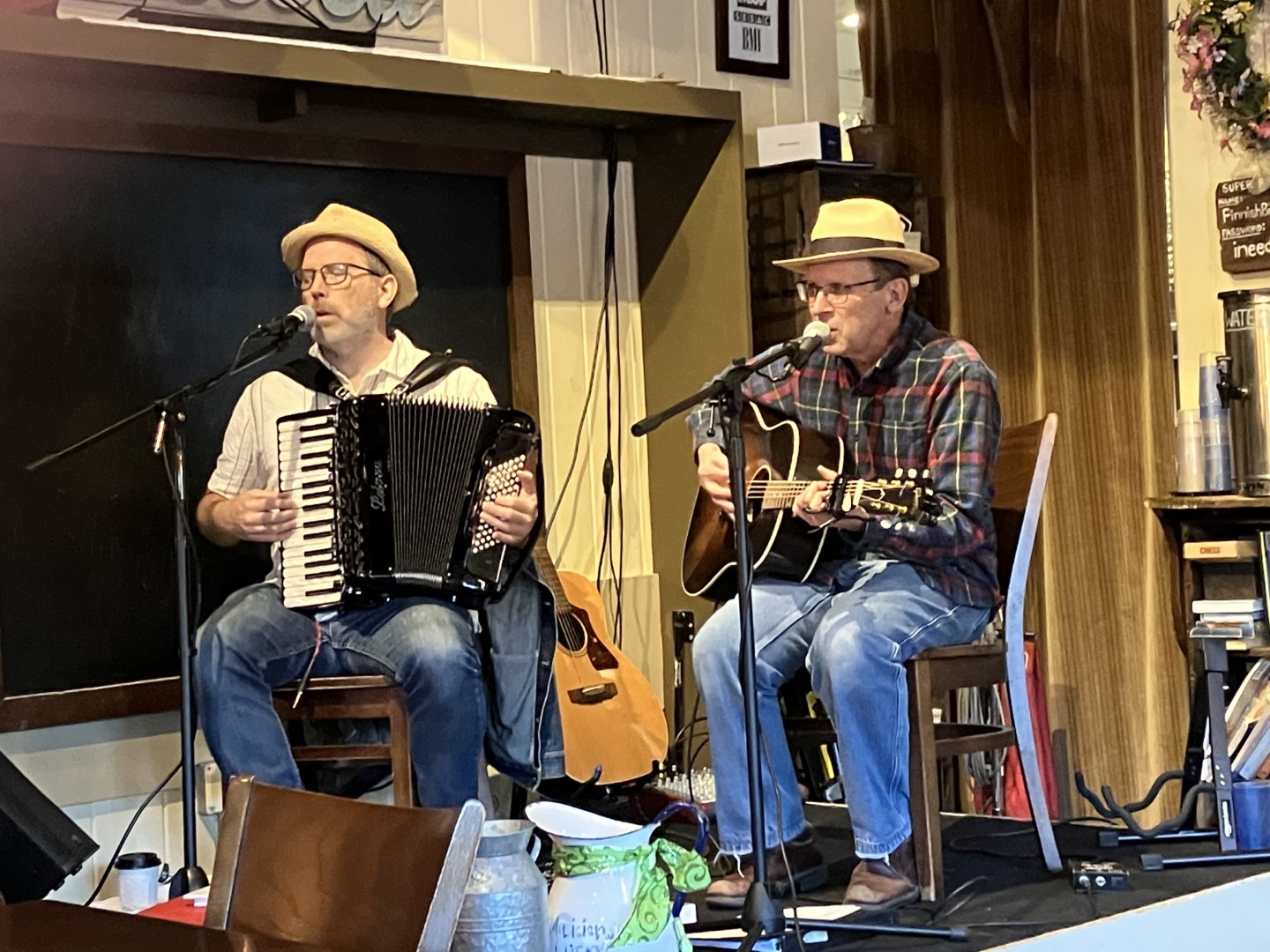
There seems to be a blossoming musical revival happening in the Twin Cities. It’s a resurgence of new musical styles and forms including Americana music. For me, it’s been sixty years from roughly 1964 to the present, for my music to come back. From a coffee shop in West Saint Paul to old Saint Anthony, there are a growing number of performance venues scattered across the Twin Cities.


Is Amore Coffee Shop in West Saint Paul the new West Bank for Americana music? What about the Finish Bistro in Saint Anthony? Could be. At one point, near the mid-seventies, many artists left the West Bank and migrated to NorthEast Minneapolis. Now there seems to be a shift taking place with that music moving to other spots in the Twin Cities. The variety of new musical styles is astounding and new venues seem to be opening up each year.


On a more personal level, I’ve always had a long-term romance with Americana music. Whether from the hills of Appalachia, the Mississippi Delta, Chicago blues, western swing, cowboy songs, or folk ballads, that style of music has grabbed my soul and interest. It began in college with the Kingston Trio, Peter, Paul and Mary and more authentic purveyors of that folk art like Bob Dylan.


‘Tangled Roots’ is one of my plays reflective of that interest. The play is really a folk concert

wrapped around a storyline under the banner of a play. A retiree, once a struggling folk singer,

wants to return to his song-writing and performing days in an era when folk music is no longer

popular. A mysterious woman might be the answer to help him along his way.

Now at the ripe age of eighty-something, I’ve taken the tentative steps of writing my own songs

for several of my plays. It will be trying to capture the mood of that era while safely ensconced

in my present-day life.


It won’t be a return to the West Bank and my quasi-hippie experiences there. Those were wrapped up in memories, real and imagined, in one of my first novels ‘Love in the AShau.’ Instead it will be exploring the song genre under the umbrella of a new play.


Song writing is hard. Lyric writing is even harder. It’s not just arranging words to fit the mood.

It goes far beyond what the ear can hear and the heart can feel. A good set of lyrics can capture

the imagination like few things in life can.


I was always enthralled by the ability of a song and its lyrics to carry me to another world, to

wrench my heart strings taunt and rip open emotions long left dormant in a sometimes cold and

uncaring world. Three minutes of sound that captured my imagination, fueled my dreams, and left

me breathless sometimes with their self-imposed imagery. I was always left wondering ‘how in

the hell were they (the songwriters) able to do that? Now I want to find out for myself.


I’m discovering a whole new batch of singer/songwriters appearing on the local musical scene.

Some are seemingly plucked right out of the folk tradition. Others bring a more current

sensibility to their performances. Either way, the message is the same as it has been for hundreds

of years. It’s a call from the open road, justice for all and the freedom to love when and where

and how one chooses.


It’s a message I’m trying to create with my own song book of my personal songs. Right now, it’s

just a roughhewn collection of song titles, lyrics, thoughts, and emotions coming from my heart

and meant for a receptive audience. If or when it gets completed, is anyone’s guess. It’s

journey I’m on as an artist and one I can’t get off of. Such is the life….

Tuesday, March 9, 2021

On the Street Where You Live

Like the emptiness of a Paris winter, we often times don’t see what’s all around us as we trudge through the streets of life. In 1929, the great French architect Le Corbusier turned from designing houses to the planning of cities. His classic book shocked and thrilled a world already deep in the throes of the modern age.

One of Le Corbusier’s favorite arguments was that there is an order to things and an order in our lives whether we know it or not. Growing up in Saint Paul, I was hardly aware of the urban changes going on all around me. It signaled the end of one period of growth for the City and a slow painful aging process that followed. Old St. Paul was gradually being replaced with a newer version of itself. Turns out there were subtle changes going on all around me while I was pondering third grade math in grade school downtown.


Old Saint Paul proper was going through its last death rattles as I boarded a city bus each day to attend ‘the little French school’ on a hill overlooking downtown. The city, which had once prided itself as the steamboat capitol of the upper Midwest, had long ago thrown on the cloak of growing wealth and opulence of its early pioneers. Thus had begun a new period of brick and mortar replacing stick buildings with turn-of-the-century modernism. Yet by the mid-to-late-forties, time and a changing demographic had spelled the end of its downtown area as a core of business, social and economic growth.

Le Corbusier had defined the parameters of a great city back around the turn of the century and metropolitan areas like the Twin Cities and New York were struggling to find and define a new definition of a livable city. Urban development ran rampant and old neighborhoods were falling victim to the times.

Old St. Paul was a Midwestern repeat of New York City’s Jane Jacobs and her continuing battles with transportation czar Robert Moses fighting to save whole neighborhoods from being swept away by elevated highways slashing through their communities. Only in the case of Saint Paul, Interstate Highway 94 won out and the Rondo community fell by the wayside.


From 1943 through 1949, I was living on the outskirts of downtown, moving from one rental to the next. Growing up near downtown St. Paul, I was too young to understand the organic changes happening all around me. Even after we moved to the Highland Park neighborhood, I was still too young to understand the ever-changing cityscape from 1949 through 1957, as I traveled to downtown St. Paul each day.


photo courtesy of Jerry Hoffman

From 1957 through 1961, I was pretty much cloistered in my own neighborhood with frequent trips to first ring suburbs like Roseville. After 1961and high school graduation, downtown St. Paul had become a place to avoid because there was nothing there of interest for me.


My horizons broadened with time in the service, living abroad, and finally settling into a hovel near the University of Minnesota. The West Bank, Como area, and Dinkytown became a place of refuge for me. Little did I know at the time that the entire area, especially north of Dinkytown, was going through revitalization with dozens of old mansions like my ghetto being torn down for modern student apartments.

Fast forward many years later and I was working at our public television’s new digs in downtown St. Paul. By the late seventies, the Lowertown area of St. Paul had started to come out of its century’s old shell of neglect and decay. The area east of the downtown core began to take on the accoutrements of an urban village; at least in the minds of developers and real estate speculators.

By then I was settled into a third ring suburb and raising kids in a modest yet comfortable environment. The thought of living in the cities never occurred to me. Jump ahead another twenty years and my daughter now lives in St. Paul, less than five blocks from where I was raised. She and her husband love their home, their neighborhood, and new St. Paul.

Sharon and I now have to travel to my old stomping grounds to see our grandchildren in a neighborhood filled with young families eager to enjoy the benefits of living in the city.

I guess it’s true; what goes around comes around.

Tuesday, September 26, 2017

Vinyl Holiday


I had to laugh. It really is true that often times what goes around comes back again. Musical taste is a good example of that. I guess if you wait long enough, the old becomes new again or at least enjoys a resurgence of interest. My old collection of musical memories from the fifties and sixties, long sequestered to basement shelves, are garnering new attention.

Vinyl is back and I’m loving it. In fact, vinyl records are so popular that Sony, the biggest of the Big Three record labels, recently announced that it will start pressing them again, as soon as March 2018, in a new factory near Tokyo. The last time Sony made a vinyl record was 1989. One could certainly argue that this announcement is just one of many signals that the music industry is once again changing with the times and customer tastes.


Aside from the obligatory roll of her eyes, my wife has been remarkably quiet about my prized collection of LPs as well as the old Sony turntable I bought but seldom use among more. Traveling the back roads of one’s mind can be a geriatric benefit for people my age. Sometimes there is a tendency to revisit old people, places and times with reflections and refractions that tend to meld into a soul-satisfying stroll down memory lane.

Vinyl can do just that. Having been down that road before, I can attest to the magic of vinyl and the old songs that take me back to yesteryear. Music has always been a huge part of my life and this renewal of interest in LPs (long playing records) just brings a smile to my face.

A while back the local web site, Minnpost, ran an article on the resurgence of vinyl records and did an interview with Bob Fuchs, general manager of the popular Minnesota record store, The Electric Fetus. It was a fascinating step back in time and remuneration of that popular phrase ‘what goes around comes around again.’

Gray's Drugs

The Triangle Bar


Back in the day when I was hanging out in Dinky Town and fantasizing about life while at the Triangle Bar, the Electric Fetus was my refuge from the storm of life. It was a magic place where overhead music played at a deafening roar and all kinds of wanna-be hippies and many of the real ones crowded the narrow aisles flipping through the stacks of vinyl.

Bob’s interview offered a fascinating glimpse into the present-day world of music and how just as things change some things remain the same. A longtime Minnesota music mainstay, Fuchs  has seen it all firsthand in his 30 years in the business (he started in the record department in December 1987).

I’ve lifted several segments from that interview and want to give full credit to MinnPost for the article. *

First, Bob was asked about vinyl at the Electric Fetus.

Bob Fuchs: In about 2000, we had 120 bins, maybe 118 of CDs and two bins of records left, and they weren’t even full. Today we’re up to nearly 50 bins of vinyl again. It’s almost 50/50 LPs/CDs now. By next year at this point, more than 50 percent of our space in the record department will be LPs.

The surprising thing to some people is we still sell CDs. They walk in and don’t even know that. They’re like, “I haven’t bought a CD in five or seven years!” We still sell twice as many CDs as LPs. Many people want physical media, whether it’s an LP or a CD. I play both every day.

Then Bob was asked about the ratio of new vinyl to used.

Bob Fuchs: Probably about twice as many used as new. In dollar amounts, new vinyl is much more expensive than most used vinyl. Most new LPs are between $17 and $25.

I think many people want to write vinyl off as a fad that’s coming back. But it was a staple for 50 to 60 years, and then there was a period of about 10 years when it wasn’t in vogue, and now it’s coming back again because of the experience.

People say they like the sound, but regardless of the quality of your musical reproduction system at home, it’s the experience. You tend to be more engaged. You sit down. You stay close. Your experience is heightened by all your senses. You’re listening, you’re reading, you’re looking, you’re appreciating art. So it’s more encompassing than just streaming a song.

An LP is the ultimate cultural artifact for music. You’ve got liner notes. You’ve got lyrics. Oftentimes, you’ve got photography, artwork, information. It’s a stamp in time, and a physical presence. A gatefold LP is 2 feet by 1 foot. It’s like a book. Some people still prefer books.

One aspect about LPs that I just took for granted were the liner notes and artwork. Apparently, a lot of people weren’t so oblivious about such things.

Bob Fuchs: When you compare most packaging now to 15 to 20 years ago, there were a lot of budget productions back then. Simple jackets, thin paper. They were minimalist and sometimes cheap. Today, people are thinking – this is the ultimate packaging. Let’s make it a gatefold. Let’s use heavier-weight cardboard or paper. Let’s press on heavier vinyl. Many people have commented at the counter that LPs are really heavy. They don’t remember them being so heavy.

Then as an unintended salute to old people’s taste everywhere, Bob explained who is leading the charge back into vinyl.

Bob Fuchs: The single biggest thing I’ve noticed is the change in demographics. This whole revival has been pushed primarily, or at least initially and still very heavily, by people under 30. There’s a much higher percentage of women buying records than there were buying CDs or records previously. What stands out most for me is the number of young women who are buying records now. In my 30 years, I don’t ever remember that many young women in the store.


Vinyl to me was the sixties personified. It was Dinkytown, the Triangle Bar, West Bank, working all day at the Public Health Department and volunteering each night at KTCA public television. It was that stunning blond working as the evening receptionist, writing poetry, attending St. John Neumann with Susan and a very brief movie-making career.

It was slow growth growing up and pondering a whole bushel basket full of ‘what if’s’ and ‘why not?’ Vinyl brings it all back home. When the needle touches skin and the music begins, I am transported back in time to a much simpler time that was good and only got a lot better.

*Portions of this interview with Bob Fuchs was taken from an article written by Ms. Pamela Espeland that appeared on the website MinnPost on July 20th, 2017. Click here to read the fullarticle.