Showing posts with label golden gate bridge. Show all posts

Thursday, December 20, 2012

Gold Coast ... the Wild Coast

The Chinese have a saying that a journey begins with a single step. I’d change that a little to say a real journey often begins in naivety, progresses to actuality by accident and somehow finds its place in one’s memory bank through sheer happenstance, perseverance and dumb luck.

Like some wonderful party that can’t be replicated afterwards even if all the same participants gathered together, once again, at the same place; a journey is really a time capsule. It’s a sliver of space in one’s life that gives birth to either good memories or bad, to wonderful thoughts or sad reflections. Yet it always remains locked in that serendipitous turn of events which can never be changed, replicated or replaced. Whatever happened did happen. Whatever was gained can’t be changed even if it later becomes lost on in a fog of future events.

A few months ago, I reflected on my experiences in San Francisco in my blog “Young Heart by the Bay.”  A tiny fraction of that experience was a road trip I took back in the autumn of 1964.

It was my first real road trip.

The idea was born early one Sunday morning in some unnamed dive bar on North Beach.


We were a motley assortment of drugstore cowboys, fast food aficionados and one kid with two years of college under his belt. Each of us ruminating on about our pending release from military service a monumental two years away. This was long before “Easy Rider” and my own sojourn to Danmark.

What were we going to do after the service? Return to college. Head out for Europe. Stay in San Francisco or hit the road just like Jack Kerouac did in “On the Road.”

The more sober philosophers among us thought we should get on with our lives. We should go back home after our hitch was up, get an education, marry our college sweetheart and settle down to the good old standard American life. The more inebriated among us thought otherwise. Another round of beers and an impromptu survey was taken. The open road garnered first place with Europe a close second. Returning home to suburban tranquility didn’t even register.

Some of us were already open road desperados. One guy had a big-ass Triumph 650cc motor-cycle with enough horsepower to fly between San Francisco to Los Angeles in record time. He went down to the city of angels almost every weekend to see his girlfriend. That is until a transfer landed him in the middle of nowhere Indiana in a snowstorm and his bike went into cold storage.

A couple of guys had souped-up cars they’d brought to the Presidio from back home. But soon one fellow was shipped off to Vietnam and another got transferred to Okinawa. Several more wannabes disappeared when sobriety raised its ugly head. So that effectively took most of my gang out of the picture. I was the only one left with my Vespa motor scooter and exaggerated, romantic notions of the open road still spinning around in my head.

A dream had been ignited in my plastic brain that resonated throughout my body. I decided I might as well hit the asphalt right then and there instead of waiting another two years before my release was up. My destination would be the distant lands north of the Golden Gate Bridge. At that point, they were just shadowy mounds of gray that kissed the skyline outside my office window.


This was the old Northern California countryside before multiple ballot propositions changed the political and social landscape and a bulging San Francisco spilled its inhabitants far and wide; spilling out across the bay to once tiny hamlets like Sausalito, Mount Tamaulipas and Stinson Beach. A time when cows roamed empty fields amid gun emplacements that still protected San Francisco bay from Japanese battleships. An era, before satellites, when radar stations scanned the northern skies for raiders from Russia. A time when only a few small enclaves of new housing slashed into the green hillsides. A time when the only sound heard was the putt-putt of my tiny Italian engine against a wind blowing ocean-side and birds on high, floating silently in the sea breeze.

So one Monday morning, instead of heading to work at the Command Information Office, I saddled up my trusty stead, wrapped supplies on the saddle rack and crossed the Golden Gate Bridge for points north.


After I had braved the crazy traffic on the bridge, I swung north to the tiny enclave of Sausalito. Even back then Sausalito was a very special place. During the war, the Navy had installed a host of ship maintenance facilities. By the sixties those had all disappeared but a lot of the ship workers had stayed. They were joined by displaced beats and hippies from across the bay. Together they made Sausalito an eclectic community, a growing artist colony and home to the funky and weird.

I got my regular cup of Joe and sat on the dock, peering out across the bay back to my new life and home and I wondered where the road might take me next.


On the way out of town, I spotted this inlet where fancy cars were parked in front and yachts in back. It was a novel idea at the time, priceless in this day and age. 


Later that morning, I stopped at the Christian Brothers winery. I didn’t see any of my old high school teachers there but a couple of glasses of vino did wonders for the rest of my trip that afternoon.


The first sign of encroaching humanity. The pristine countryside of Sausalito was becoming just another suburb of San Francisco. 


Some rundown motel among the sequoias was my refuge for that first night. Exhausted, dirty and yet feeling exhilarated. Note the sleeping bag I had hauled along. What was I thinking?


This was one of dozens of inlets along the coast road where the sea had dumped its collection of driftwood and debris on land. I’m sure there were treasures down there but I never stopped to investigate

 
I was so tempted to ride down to this house to see who lived there. I can’t image a more remote, mysterious and wonderful place to live. It was probably some writer toiling on the great American novel and suffering the pangs of a broken love affair.


Back along the bay, I came across this new military housing complex being built. The view out their front door was to die for.


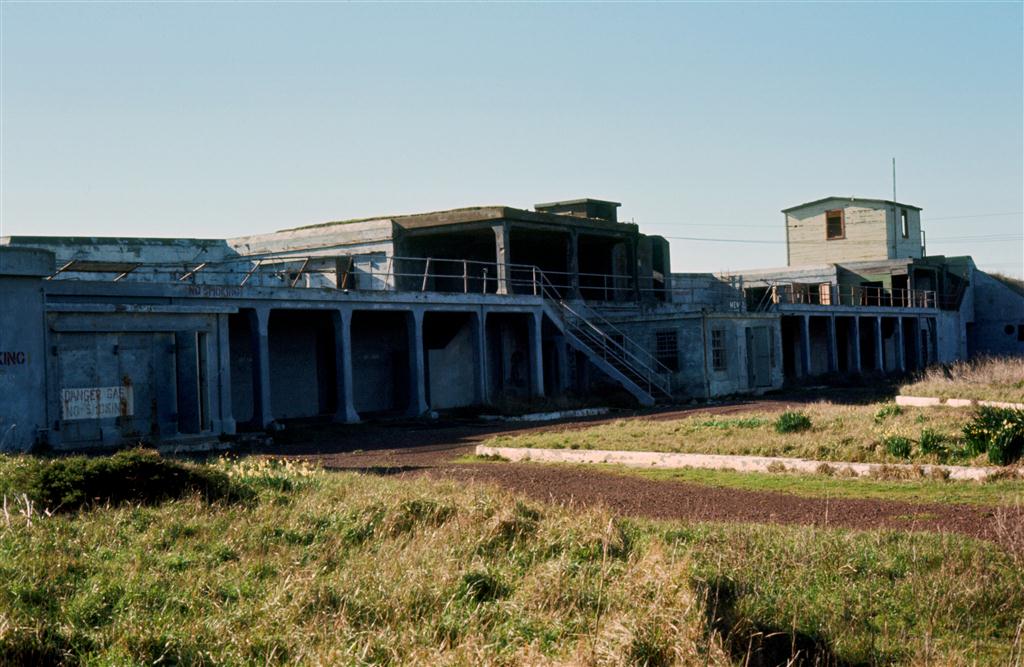
But more fascinating were the old World War Two defensive installations that ran up and down the bayside. A concrete collection of pillboxes, command centers and the foundations for large cannons which would have been pointed out to sea.


Then behind those old fortifications was a new radar facility and cameras pointed down at a kid on a scooter who was peering up at them.


Some of the dozen places along the coast where I was lost and didn’t really care. I had gas to go and wanderlust running rampant through my veins. 


By the end of the week, I was flying with wild abandon. Yet I only crashed once, taking a curve too fast on wet leaves and ending up in a gully sans my glasses, hat and pride. The scooter was OK except for the mud and leaves that coated its undercarriage with brown muck.  I found my glasses, picked the dirt out of my teeth and climbed back up on the saddle again.

During that week, one song in particular kept bouncing around in my head. “Four Strong Winds” by Ian and Sylvia. It spoke of loss, separation and the infinitesimal yearning for something better even if ‘it’ couldn’t be defined at the time. It’s a great song and still brings back a lot of fond memories.

After a week of meandering the bays and inlets, the back roads and tiny towns hugging the coast, I immerged out of a grove of redwood trees and found myself by some main artery that fed humanity back down toward the bay area. I used that as a beacon to head back south and my home.


The trip was soon forgotten and aside from being captured in some old color slides it became a fading memory that was soon overshadowed by a multitude of other life events including a traumatic trip home between transfers. Yet somehow those old slides followed me around for another forty-six years until a friend suggested I transfer them to digital.

ScanCafe released them from their cardboard sleeves and jogged a memory capsule in the back of my head. After gathering dust for forty plus years, those images took me back to a time when I was young and free and full of wondrous ideas and aspirations.

I realize now that during my trip I was living in the moment…what Buddhists all mindfulness. Today we would translate that as conscious living.  In his book “Wherever You Go There You Are – mindfulness meditation in everyday life,” author Jon Kabat-Zinn talks about mindfulness as enlightening and liberating work. “It is enlightening in that it literally allows us to see more clearly, and therefore come to understand more deeply, areas in our lives that we were out of touch with or unwilling to look at.”

I should ride a scooter more often.

My California coastal tour was the first of several road trips. That was then, this is now. I’m not much for road trips anymore. I guess I’m too impatient to get wherever I want to go. But back then, it was my first time skirting asphalt and concrete, tasting the grit and grime of the open road and opening my virgin mind to all kinds of possibilities. Some of which actually came true.

Life can be strange that way.

Tuesday, September 4, 2012

Young Heart by the Bay


 I’ve been criticized sometimes for dwelling in the past, focusing my writing energies on that long forgotten period of lost youth, unrequited love, wandering ambitions and unfocused goals. That theme has crept into two of my novels and a number of my blogs. Sometimes subtle, sometimes blatant but always present.

I plead guilty. And after observing some of the lives around me, I am more than content to continue fighting that long slow slide toward mediocrity. Without dwelling there, I think I can revisit my past, reflect on the good and the bad planted there and still relish my present situation.

I thought about that when I read Scott McKenzie’s obituary in the San Francisco Examiner a couple of weeks ago. It’s a heck of a thing when one song can perfectly encapsulate the soul of a city. San Francisco has two such songs.

The first was “I Left My Heart in San Francisco” by Tony Bennett. Tony’s song, although great make-out music, was really for the old guard. The more mature, three-piece suit and formal dress folks who sipped martinis and talked race horses. That was their world. Mad Men, anyone?


On the other hand, Scott McKenzie’s song helped define my generation. Or at least a large part of my generation. It gave San Francisco its moniker as the epicenter of the 1960’s counterculture. The city has always been a kind of border town, attracting both freaks and fearless alike. It still harbors that open, accepting attitude for folks of all kinds. Boulder, Colorado, boasts a bumper sticker which reads, “Keep Boulder Weird.” San Francisco has been weird since its gold rush days.


Scott’s song was able to capture that very brief period in 1967 when flowers were in bloom and flower children captured our imagination. The sixties was a magical time at the Presidio of San Francisco and San Francisco in general. I was very lucky to experience both of them briefly when I was in the service and stationed at the Presidio.

Without really knowing it, I was experiencing the whole pre-hippie era, mixing and mingling with hippies and diggers, black panthers and anti-war activists, Berkeley intellectuals and disciples of the Age of Aquarius. All from the security of an army bunk at the Presidio.

The Presidio of San Francisco (originally called El Presidio Real de San Francisco) is a former military base located on the northern tip of the San Francisco Peninsula.

Originally built as a Spanish Imperial Outpost from 1776 to 1821, the Presidio was the Spanish empire’s northernmost military outpost. In 1821, the Presidio changed from Spanish to Mexican sovereignty. Then during the Mexican-American War in 1846, the army took over the post and occupied it until 1972 when it was included within the boundaries of the Golden Gate National Recreational Area. In 1996, it was formally closed and transferred to the National Park Service.


I only spent a very brief period of my lost years at the Presidio. It was between the summer of 1964 and spring of 1965. I had just left basic training at Fort Leonard Wood, Missouri (affectionately known as the armpit of the army) and was being transferred to the Presidio of San Francisco (romanticized as the country club of the army, which it was!). I would later be transferred to Fort Polk, Louisiana (correctly known as the a…… of the army).

As an Information Specialist in the Command Information Office, I had a nine to five job and plenty of spare time to explore my newly adopted cityscape. The view from my office was spectacular. For the relatively brief time I was there, I managed to pack in a lot of experiences. Unfortunately I only captured a few of them on film.


Before the service, I had never been out of Minnesota, flown in an airplane or done a cross country road trip. San Francisco opened my eyes to a wondrous new world all around me. It defined the beginnings of my wanderlust and a quest to answer those long dormant hunger pangs.

In a very short time, I became one of the wealthiest men in my barracks – in service lingo. I had a library of over 100 paperback books available for lending out, a record collection of: 45 rpm hits, a Vespa motor scooter and most importantly, a second job at an art theater.

That job earned me almost one hundred dollars a month after taxes. I was saving my army pay of eighty dollars a month and only spending part of my secondary income. I was the classic big fish in a small khaki pond.


The Larkin Theater was an art house theater that specialized in foreign films. Most of the time, two girls and I ran the place. At least the owner let us believe we did. My job was ticket taker, usher, janitor, Saturday morning phone secretary and overall gopher. The two ticket takers (whose names I’ve long since forgotten) were high schoolers working part-time until they could squeak through 12th grade and move on to cosmetology school. Our backgrounds were similar and we became comrades in the arts.


I absolutely loved my job. It was my first introduction to foreign films, which I love to this day. Ninety percent of my films from Netflix are foreign films.

In 1964, Haight-Ashbury was just a nondescript street corner in a rundown part of town. I went there many times to hang out with a couple of ex-servicemen. They had girlfriends upstairs and weed in the fridge. And a lot of very strange visitors. A quiet night was lounging in their hammocks, drinking cheap wine and listening to jazz or pre-psychedelic rock and roll.

When we were buzzed enough, I’d climb aboard my Vespa and weave my way back to the Presidio, hoping that neither cop nor curb would curtail my long ride home. I’m embarrassed by my actions now but back then it was all part of the lifestyle of any service man on the loose in the big city.


With my Vespa under foot, I began exploring the city. Flying up and down the hills, I rode through the Marina, the Palace of Fine Arts (before restoration), Nob Hill, Market Street, Golden Gate Park and the beach. Just to name a few. Back then, I was probably riding too fast, drinking and driving and never wearing a helmet. Fortunately, I survived the stupidity of my youth.


I traveled up and down the coast on weekends, south down to Half Moon Bay and north up to Sausalito, Stinson Beach, Mount Tamalpais and the numerous World War Two fortifications across the bay from the Presidio.


Back then, Sausalito was just a small town across the bay. It began as a ship repair yard during World War Two and grew exponentially after that. By the early sixties a lot of the Beats had migrated from San Francisco to Sausalito. They hung out in the dank dreary bars and coffee shops that dotted the waterfront.


Everyplace I’ve lived, visited or hung around has had its fair share of characters. The Presidio was no different.

My entrepreneurial skills were nothing compared to the young dark-skinned fellow who always had several girlfriends in his posse. He lent them out to friends and associates-for a price. We thought he was quite a businessman back then. Today you’d just call him a pimp.

There was the natural born hustler who worked evenings attending to the mainframe (pre) computer in company headquarters and then did other people’s KP duty (kitchen patrol) five days a week. His going rate was $25.00 dollar cash per day, non-negotiable. He always had willing takers lined up outside his barracks door. That’s $500.00 cash per month – back in 1964. And he didn’t pay taxes on it either!

I befriended an angry black man who hated whites. Go figure. He liked me because I wanted to be a writer. He was a writer and felt a kinship to my vernacular struggles despite my pale skin.

I envied the two GIs whose sole job was to travel each day to Sausalito to maintain the general’s yacht docked there. They were even allowed to take it out for a cruise just to test the engines. I begged to go along but they always refused my request. Something about their Golden Egg.

There was a German immigrant who got drafted and meant to better his English while serving his new found country. While he practiced his diction on me, he introduced me to the arts in San Francisco. Together we attended numerous plays, art gallery openings and museums. We saw “Fantasticks” and the song “Try to Remember” broke my heart thinking about someone back home. My friend was a lot smarter than I was but I think he found in me a willing student to learn about the arts.

We had an illustrator in our barracks. He and I would get into heated arguments all the time because he hated Joan Baez. Who doesn’t like Joan Baez? Other than that, he was an incredibly talented artist and great guy in his own right.

I befriended the intellectual of our group of malcontents. Evenings and weekends, he was flipping Victorian houses, ‘Old Ladies,’ before it became trendy. He invited me to join him in his real estate ventures. Like an idiot, I said no because I had a real job. Besides, who makes money by fixing up old houses in San Francisco and then selling them for three to four times their purchase price?

We always laughed at the fellow who got blind drunk every weekend. We thought it a bit obsessive but not particularly out of character for the characters around us. Strange how attitudes change over time. Now I feel nothing but compassion for him and wonder what must have become of him.

But most memorable, was the young female recruit in my office, who was working her way up through the ranks (literally). She preferred officers, especially the married ones whose wives were in other states. She had no shame. She was a working girl. And very good at what she did. Mind you, her typing skills were atrocious. Not that it mattered very much.

My stay in San Francisco ended all too quickly with marching papers to Louisiana and an end to the wonderful fantasy world that had been all mine for that brief period of time.

I’m grateful I was able to capture on film some of those moments if for no other reason than to use them as screen savers and as an excuse to reflect back on a time when peace and love ruled the world and a kid, full of wild ideas, lived briefly in that city on the bay.